Mary: Mother of God
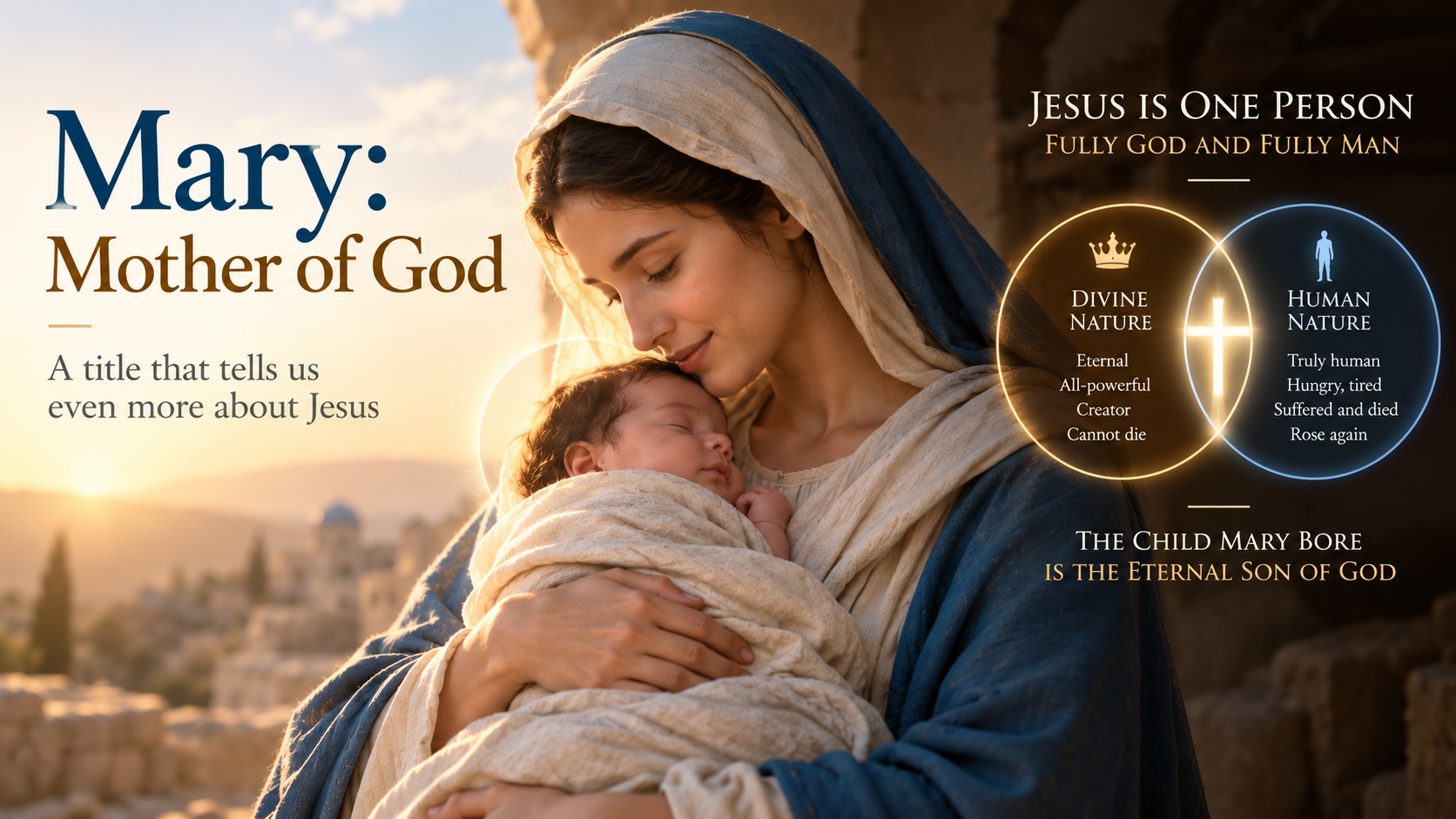
You may have heard that we call Our Lady the Mother of God.
You may have thought:
“That is a really weird thing to call a human woman! How can Catholics say that she is God's mother?”
That's a fair question.
But really, the title “Mother of God” is more about Jesus than about Mary.
Read on.
What was Mary's role?
Let's start with something very simple.
Galatians 4:4
“But when the time had fully come, God sent forth his Son, born of woman, born under the law.”
And then, at the Annunciation:
Luke 1:30–31
“And the angel said to her, ‘Do not be afraid, Mary, for you have found favour with God. And behold, you will conceive in your womb and bear a son, and you shall call his name Jesus.’”
Clearly, Mary did not create God.
She was invited to participate in God's plan to bring about the Incarnation for our salvation.
God was not waiting for Mary to somehow create His Son.
Rather, the eternal Son of God was sent by the Father and, through the power of the Holy Spirit, took flesh in Mary's womb.
Now that we have covered that, let's leave Mummy Mary aside for a moment.
Let's focus on who she bore in her.
What is Jesus?
Is Jesus God?
Is Jesus man?
Is He a man who became God?
Or is He God who was somehow demoted into becoming a man?
Or is He half-man, half-God, like a Merlion?
😂
From Scripture, it is quite clear.
John 1:1, 14
“The Word was God…”
and:
“And the Word became flesh and dwelt among us.”
Colossians 2:9
“For in him the whole fulness of deity dwells bodily.”
And Scripture is equally clear that this divine Son truly became human.
Galatians 4:4
“God sent forth his Son, born of woman.”
Romans 1:3
“His Son, who was descended from David according to the flesh.”
Jesus is the Son of God, sent into the world and born of a woman.
He is God who became man.
He is fully God and fully man.
And this is where things get interesting.
Did Jesus have a human soul?
What does it actually mean to be human?
A human being is not merely a body.
We are body and rational soul.
And Jesus became truly human.
So when the eternal Son became man, He did not simply take on a human body.
He assumed a complete human nature — body and rational human soul.
This is important.
Jesus did not have a divine nature that temporarily operated a human body like a puppet.
The eternal Son truly became man.
His divine nature did not change into a human nature.
Instead, the Son assumed a human nature.
So:
One Person.
Two natures.
The divine nature.
And the human nature.
This is what Christians call the hypostatic union.
It is a mystery, and it is not something we can completely explain.
But we can understand what the Church is saying.
One Person, Two Natures
Jesus is not half God and half man.
He is not 50% God and 50% man.
He is fully God and fully man.
He is one Person — the eternal Son of God — with both a divine nature and a human nature.
I cannot use kopi O to describe Jesus.
One nature being the coffee and the other being the sugar, both mixed together in one cup.
Not quite.
Because I can separate the sugar from the coffee.
I cannot use durian flesh and durian seed either.
Those can also be separated.
And I certainly cannot use carbon dioxide, where one state is gas and another is dry ice.
That's one substance changing state.
Jesus isn't that either.
His divinity did not turn into humanity.
His humanity did not turn into divinity.
And His humanity did not somehow exist as a separate person alongside the divine Son.
He is one Person.
Fully God. Fully man.
How is Jesus human? How is He divine?
Because Jesus has a true human nature, He can experience genuinely human things.
His human nature could become tired. - John 4:6
He could become hungry. - Matthew 4:2
He could suffer. - John 19:1–3, Luke 22:44
And He could die, and shed blood. - John 19:30–33
These aren't pretend human experiences.
Jesus really became human.
But Scripture also shows us things that reveal His divinity.
He forgives sins. - Mark 2:5–7
He walks upon the water. - Matthew 14:25
He calms the storm. - Mark 4:39–41
He knows what is in people's hearts. - John 2:24–25
And ultimately, He rises from the dead.
None of these things mean there are two Jesuses.
The human experiences belong to His human nature.
The divine attributes belong to His divine nature.
But both belong to the same Person.
The eternal Son of God.
What is Jesus NOT?
Just to be clear:
- God did not simply make a human body, give it the name Jesus, and then have the Son of God climb inside it and operate it like a puppet.
- Jesus did not start out as merely a human being who was later promoted or adopted by God.
- And there aren't two Jesuses: One divine Jesus and one human Jesus.
- Jesus is not two different people living in one body.
He is one Person with two natures.
The Church had to defend this truth against several different misunderstandings throughout history.
- Some denied His true humanity.
- Some denied His true divinity.
- Some divided His humanity and divinity too far, treating Jesus as though He were two persons — one divine and one human.
- Others blurred the distinction between His divinity and humanity, as though one nature had absorbed or changed the other.
The Church eventually articulated the language we use today very carefully:
One Person. Two natures. Fully God. Fully man.
So what does Theotokos mean?
Now let's come back to Mary.
The question is:
Who did Mary give birth to?
Yes.
You get the point.
She gave birth to Jesus.
And who is Jesus?
The eternal Son of God.
The Person who is fully God and fully man.
And therefore:
Mary is the Mother of God.
In Greek:
Theotokos. Θεοτόκος.
The term is often translated as “God-bearer” or “Mother of God.”
And this is where the title becomes extremely important.
Because the Church isn't saying something extraordinary about Mary simply because it wants to give Mary an extraordinary title.
It is making a statement about who Jesus is.
Why does the title protect Christology?
And this is where the whole thing gets serious.
In the fifth century, there was a controversy surrounding Nestorius, Patriarch of Constantinople.
At the heart of the controversy was a question:
How are the humanity and divinity of Jesus united?
Nestorius resisted calling Mary Theotokos, preferring language such as Christotokos — “Christ-bearer”.
His concern sounds reasonable at first:
How can Mary be called “Mother of God” when God is eternal?
Mary obviously did not give God His existence.
And that part is absolutely true.
Mary did not give the Son His eternal divine existence.
But the deeper question is:
Who is Jesus?
If we speak as though the human Jesus is one person and the divine Son is another person, then we have divided Christ.
The Church's answer is much more precise:
Christ's humanity is distinct from His divinity, but it is not separate from the Person of the Son.
His human nature is not another person.
It belongs to the eternal Person of the Son.
This means that at the Cross, Jesus really suffers and dies according to His human nature.
But who suffers and dies?
Not a separate human person.
The Person who suffers and dies is the divine Son.
So Christians can legitimately say:
“God the Son suffered and died for us.”
Not because God's divine nature can experience pain or death.
But because the Person who experienced pain and death was the divine Son, acting through His human nature.
And that is absolutely central to the Gospel.
The one who suffered and died for us is truly God.
If Jesus were merely a human person somehow joined to God, then we would have a very different Christ.
And that would completely change the meaning of the Cross.
How Was the Controversy Resolved?
The early Church didn't invent these questions centuries later.
The apostles themselves gathered in council when serious questions about the faith arose. We see this in Acts 15:6:
“The apostles and the elders were gathered together to consider this matter.”
As the Church grew, councils continued to be used to address major questions of faith.
In AD 431, the Council of Ephesus addressed the controversy surrounding Nestorius and the question of how we should understand Jesus Christ.
But notice something important.
The Council was not primarily asking:
“How important is Mary?”
The deeper question was:
“Who is Jesus Christ?”
To understand the controversy, we need to remember what we have established earlier in this article:
Jesus Christ is one divine Person — the eternal Son of God — who truly became man. He possesses two complete natures: divine and human.
He is not two persons, one divine and one human. Nor is He a human person who was later joined to God.
The Person born of Mary is the same eternal Son who existed from all eternity.
And this is why the Council affirmed Mary's title:
Theotokos — Mother of God.
The Catechism explains the underlying truth this way: Christ's humanity has no other subject than the divine Person of the Son, who assumed it and made it His own from His conception (CCC 466). Read the Catechism.
In other words, the Church was not saying:
“Mary is important, therefore we should call her the Mother of God.”
It was saying:
“The Person Mary bore is God the Son, who truly became man.”
THIS is the Christological statement.
We can reduce it to:
- Jesus Christ = One Person
- That Person = the eternal Son of God
- That Person possesses = divine nature + human nature
Therefore:
- Mary gave birth to the Person who is God the Son.
Therefore:
- Mary is Theotokos — Mother of God.
This does not mean:
- Mary created God or existed before Him.
- Mary is divine.
- Mary's human nature became divine.
- Jesus is half God and half man.
- Jesus is two separate persons.
It means that the child Mary bore was truly human, yet He was never merely a human person. He was God the Son Himself, who took on our human nature and became man.
What happens if we reject “Mother of God”?
I understand the discomfort.
Calling a mere human woman the “Mother of God” sounds almost outrageous.
But rejecting the title can create a much bigger problem.
If we insist that Mary is only the mother of a human Jesus who is somehow separate from the eternal Son, we risk dividing Christ into two persons.
And if Jesus' humanity is separated from the divine Son, then who exactly suffered and died on the Cross?
A merely human person?
That cannot give us the full Christian Gospel.
The Scriptures had already foretold a Messiah who would suffer.
Isaiah 53 speaks of the Servant who is wounded for our transgressions and bears the sins of many.
Psalm 22 describes the suffering of the righteous one in remarkable detail.
And the New Testament tells us that this suffering Messiah is Jesus Christ, the Son of God.
So boldly, Christians proclaim:
The Son of God suffered and died for us.
Not because God ceased to be God.
Not because His divine nature became capable of suffering.
But because the Person who suffered and died was the eternal Son of God, who had truly taken on human nature.
This is why the title Mother of God matters.
It protects the truth about Jesus.
Elizabeth already gives us a glimpse
And there is something beautiful in Luke's Gospel.
After the Annunciation, Mary goes to visit Elizabeth.
Gabriel has just told Mary:
Luke 1:35
“Therefore the child to be born will be called holy, the Son of God.”
Mary then visits Elizabeth.
Elizabeth is filled with the Holy Spirit and says:
Luke 1:43
“And why is this granted me, that the mother of my Lord should come to me?”
Notice the timing.
Elizabeth calls Mary:
“the mother of my Lord.”
She hasn't merely said:
“The mother of the future Messiah.”
She says:
“the mother of my Lord.”
The Greek word is Kyrios — “Lord”.
And Luke has just told us that the child in Mary's womb is the Son of God.
The Church therefore sees in Elizabeth's words an important biblical foundation for Mary's divine motherhood.
The Catechism itself points to Luke 1:43 when explaining why Mary is truly called Mother of God.
Mary really became Jesus' mother
And this is where Mary's role becomes quite awesome.
Mary did not merely provide Jesus with a body while someone else somehow supplied His humanity.
The child conceived in her womb was the Person of the Son, possessing the complete human nature He had assumed.
Mary carried Him.
Mary gave birth to Him.
Mary nursed Him.
Mary raised Him.
She watched Him grow.
She knew His human face, His human voice, His human touch.
And the Person she carried and gave birth to was God the Son incarnate.
That is why the Church calls her:
Theotokos — God-bearer.
Mother of God.
Not because Mary is divine.
Not because Mary existed before God.
Not because Mary created God.
But because:
The Person Mary gave birth to is God the Son.
And this brings us to the Eucharist
Now, you might be wondering:
What does all this have to do with the Eucharist?
Quite a lot, actually.
Jesus gave us His Flesh to eat. At the consecration, the bread and wine become the Body and Blood of Christ.
But remember what we have just established.
Jesus cannot be divided into separate persons.
The Jesus who is present in the Eucharist is the whole Christ.
Therefore, under the appearance of bread, Christ is truly present:
Body, Blood, Soul and Divinity.
And under the appearance of wine:
Body, Blood, Soul and Divinity.
We aren't receiving merely Jesus' physical body separated from His soul and divinity.
We receive Jesus Himself.
The whole Christ.
Body, Blood, Soul and Divinity.
Why Does This Matter to Catholics?
Calling Mary the Mother of God is not just about Mary. It is about who Jesus is.
The child Mary carried, bore, and called her Son is God the Son, who truly became man. He is the same Jesus who suffered and died for us, rose from the dead, and whom we receive in the Holy Eucharist — Body, Blood, Soul and Divinity.
When we call Mary Theotokos, we are proclaiming a truth about Jesus:
He is truly God. He is truly man. And He is one divine Person — God the Son.