Holy Eucharist: The Passover
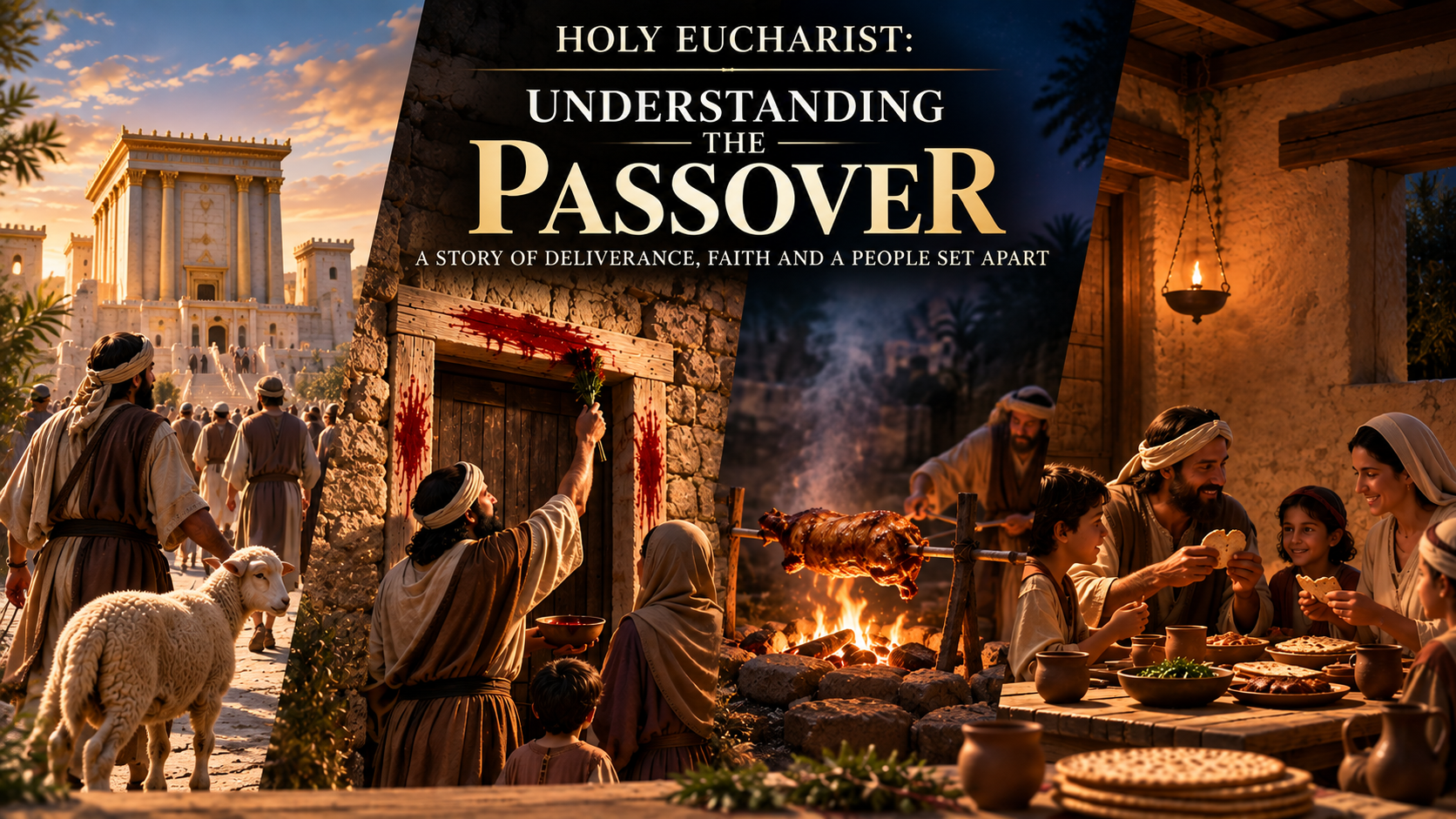
Long post. Please use the Table of Contents for navigation.
Understanding the Feast God Gave Israel
Before we can understand why Catholics see the Eucharist as the fulfilment of the Passover, we first need to understand the Passover itself.
The Passover is one of the most important feasts in the Old Testament. It was instituted by God Himself as part of Israel's deliverance from slavery in Egypt, and God gave His people very specific instructions about how it was to be celebrated.
It was not simply a story to remember.
It was a feast to be celebrated.
It was a sacrifice.
It was a meal.
And it was to be kept throughout the generations.
Before we look at what Jesus did at the Last Supper, let's first understand what God commanded concerning the original Passover.
A Feast to Be Kept Forever
Exodus 12:14
"This day shall be for you a memorial day, and you shall keep it as a feast to the Lord; throughout your generations you shall observe it as an ordinance for ever."
Exodus 12:24
"You shall observe this rite as an ordinance for you and for your sons for ever."
The first Passover was instituted by the Lord through Moses and Aaron before the final plague came upon Egypt.
God gave His people detailed instructions for that night.
But He also made something very clear:
This was not to be a one-time event.
The Passover was to become a perpetual observance for Israel.
The generations that came after the Exodus were to celebrate it as a memorial of what God had done for His people.
The Passover therefore became an essential part of Israel's covenant life.
How Important Was It to Celebrate the Passover?
The importance of the Passover becomes even clearer in the Book of Numbers.
The Israelites were now in the wilderness, and God commanded them:
Numbers 9:1–2
"Let the people of Israel keep the passover at its appointed time."
The appointed time was the first month, on the fourteenth day.
But what happened if someone was genuinely unable to participate?
Some Israelites were ceremonially unclean because they had touched a dead body. Others might have been away on a journey.
They asked Moses what they should do.
God provided an answer.
Numbers 9:10–11
"If any man of you or of your descendants is unclean through touching a dead body, or is afar off on a journey, he shall still keep the passover to the Lord. In the second month on the fourteenth day in the evening they shall keep it; they shall eat it with unleavened bread and bitter herbs."
This is known in Jewish tradition as Pesach Sheni, the Second Passover.
But it is important to understand what this means.
God did not establish two ordinary Passover dates from which people could simply choose whichever was more convenient.
Rather, He provided a second opportunity for those who were legitimately prevented from celebrating at the appointed time.
The message is striking:
If someone was prevented from participating for a legitimate reason, God made provision so that they could still celebrate the Passover.
The Passover was that important.
The Passover in the Wilderness
Numbers 9 gives us another glimpse of how seriously Israel was expected to observe the Passover.
Even after leaving Egypt, the Passover remained part of their covenant life.
Numbers 9:1–3
"And the Lord spoke to Moses in the wilderness of Sinai, in the first month of the second year after they had come out of the land of Egypt, saying, "Let the people of Israel keep the passover at its appointed time.""
God commanded Israel to keep it at its appointed time.
And when some people were prevented from celebrating because of ritual uncleanness or being away on a journey, God provided the Second Passover.
The important point is that the Passover did not end when Israel left Egypt.
The event happened once.
But the memorial celebration continued.
God commanded generation after generation to celebrate it.
What If Someone Simply Refused?
Numbers 9 then gives us the other side of the picture.
Numbers 9:13
"But the man who is clean and is not on a journey, yet refrains from keeping the passover, that person shall be cut off from his people, because he did not offer the Lord's offering at its appointed time; that man shall bear his sin."
That is remarkably strong language.
The Passover was not presented as an optional cultural tradition.
If an Israelite was able to participate but deliberately refused, there were serious consequences.
God had commanded His people to celebrate the Passover.
What Exactly Was the Passover?
So what did the Passover actually involve?
God gave very specific instructions.
1. A Lamb Was Chosen
Exodus 12:3
On the tenth day of the month, each household was to take a lamb.
2. The Lamb Had to Be Without Blemish
Exodus 12:5
"Your lamb shall be without blemish, a male a year old."
The Passover sacrifice was not to use just any animal.
It had to be a lamb without blemish.
3. The Lamb Was Kept Until the Fourteenth Day
Exodus 12:6
The lamb was kept until the fourteenth day of the month.
Then:
"the whole assembly of the congregation of Israel shall kill their lambs in the evening."
The sacrifice therefore happened at a very specific time.
4. Its Blood Was Applied to the Doorposts
Exodus 12:7
"Then they shall take some of the blood, and put it on the two doorposts and the lintel of the houses in which they eat them."
God later explains the significance of the blood:
Exodus 12:13
"The blood shall be a sign for you, upon the houses where you are; and when I see the blood, I will pass over you."
The blood was therefore a sign of God's protection.
The final plague would come upon Egypt, but the houses marked with the blood of the lamb would be spared.
5. The Lamb Was Eaten
This is an important detail.
The Israelites were not merely instructed to sacrifice the lamb and apply its blood.
They were commanded to eat it.
Exodus 12:8
"And they shall eat the flesh that night, roasted; with unleavened bread and bitter herbs they shall eat it."
The Passover therefore involved both sacrifice and a meal.
The lamb was sacrificed.
Its blood was shed and applied.
And its flesh was eaten.
6. The Lamb Was to Be Roasted, Not Boiled
God was even specific about how the lamb was to be prepared.
Exodus 12:9
"Do not eat any of it raw or boiled with water, but roasted, its head with its legs and its inner parts."
The manner of preparation was part of God's instruction.
This was not simply an ordinary meal with a lamb.
It was a sacred meal with specific requirements.
7. Nothing Was to Remain Until Morning
Exodus 12:10
"And you shall let none of it remain until the morning, anything that remains of it until the morning you shall burn."
The Passover lamb was to be consumed as part of the meal.
Anything remaining in the morning was not simply to be saved for another meal.
It was to be burned.
8. They Were to Eat in Haste
The Israelites were not sitting down for a leisurely dinner.
God instructed them:
Exodus 12:11
"In this manner you shall eat it: your loins girded, your sandals on your feet, and your staff in your hand; and you shall eat it in haste."
Why?
Because they were about to leave Egypt.
The Passover was connected directly to their liberation.
They were about to leave slavery behind.
9. None of Its Bones Were to Be Broken
God gave another very specific instruction:
Exodus 12:46
"Neither shall you break a bone of it."
This same instruction appears again when the Passover is celebrated in the wilderness.
Numbers 9:12
"They shall leave none of it until the morning, nor break any of its bones."
The Passover lamb was therefore subject to yet another specific requirement: none of its bones were to be broken.
Can I Change the Rules a Little?
Okay, God gave very specific instructions for the Passover. But what if I make a few small adjustments?
1. "This lamb has a broken leg, but it's cheaper. Can I use it?"
Well, first, God required the lamb to be without blemish (Exodus 12:5).
And separately, He commanded:
"Neither shall you break a bone of it."
— Exodus 12:46
So no — this isn't something they could modify.
2. "I don't have a lamb. But I have a perfectly good, unblemished chicken. Can I use that instead?"
No.
God specifically commanded a lamb (Exodus 12:3).
3. "Okay, I have the correct lamb. But I don't like lamb. Can I sacrifice it, put the blood on the door, and skip eating the meat?"
No.
God explicitly commanded:
"They shall eat the flesh that night."
— Exodus 12:8
4. "Fine. I'll use the lamb. But can I use chicken blood on the doorposts instead?"
No.
It was the blood of the Passover lamb that was to be applied (Exodus 12:6–7).
5. "Everything else is correct. But I don't like roast lamb. Can I stew it? Or make curry?"
Still no.
God specifically commanded that it be roasted with fire, and prohibited eating it raw or boiled in water (Exodus 12:8–9).
You get the point.
These questions may sound a little ridiculous, but they reveal something important.
The Passover was not something the Israelites could modify according to their preferences.
God gave them specific instructions.
The lamb mattered.
Its condition mattered.
Its blood mattered.
Its flesh mattered.
Even how it was prepared mattered.
And importantly, the lamb was not merely sacrificed.
It had to be eaten.
That detail will become very interesting when we eventually look at the New Passover.
The Passover Was More Than the Blood
At this point, it is worth pausing.
It would be easy to reduce the Passover to one element:
"The blood saved them."
And the blood was indeed central.
God explicitly said:
"When I see the blood, I will pass over you."
But the Passover was not merely the application of blood.
God commanded a complete ritual:
A lamb was selected.
The lamb was sacrificed.
Its blood was applied.
The lamb was eaten.
The meal was celebrated according to specific instructions.
This distinction will become very important when we later examine the Eucharist.
For now, we simply need to understand what the Passover actually was.
The Passover Was a Memorial
1. God Repeatedly Mentioned Memorial
The Passover was not intended to be celebrated only by the generation that came out of Egypt.
God repeatedly instructed Israel to remember and celebrate the Passover throughout their generations.
Exodus 12:14
"This day shall be for you a memorial day, and you shall keep it as a feast to the Lord; throughout your generations you shall observe it as an ordinance for ever."
The same instruction appears again:
Exodus 12:24
"You shall observe this rite as an ordinance for you and for your sons for ever."
And when Moses gives instructions concerning the Feast of Unleavened Bread:
Exodus 13:8–10
"And you shall tell your son on that day, 'It is because of what the Lord did for me when I came out of Egypt.' ... You shall therefore keep this ordinance at its appointed time year by year."
The Exodus happened once.
But God commanded its memorial celebration to continue from generation to generation.
This raises an important question:
What exactly did God mean by "memorial"?
Was Israel simply being told to remember something that happened in the distant past?
2. What Does "Memorial" Mean?
When we hear the word "memorial", we might think simply of remembering something that happened in the past.
But the biblical understanding of memorial is richer than simply recalling a historical event.
This becomes especially interesting when we look at the Greek word ἀνάμνησις (anamnesis), meaning remembrance or memorial.
In Scripture and the liturgical tradition, anamnesis points beyond merely thinking about something that happened in the past. It is connected with proclaiming and celebrating God's saving works.
We can see this more clearly in the way Israel was taught to speak about the Exodus.
3. "What the Lord Did for Me"
Exodus 13:8
"And you shall tell your son on that day, 'It is because of what the Lord did for me when I came out of Egypt.'"
Think about that statement.
A father teaching his son this command might have been born generations after the Exodus.
He had never personally stood in Egypt.
He had never stood before Pharaoh.
He had never crossed the Red Sea.
Yet he was instructed to say:
"What the Lord did for me when I came out of Egypt."
Not merely:
"What the Lord did for our ancestors."
The Passover was teaching each generation to identify itself with the saving act of God.
The Exodus happened once.
But every generation was commanded to enter into its memorial celebration.
The Exodus happened once. Yet through the Passover memorial, each generation was taught to identify itself with God's saving work.
4. "We Were Slaves"
Deuteronomy gives us another remarkable example.
When a child asks why Israel keeps God's commandments, the father is instructed to answer:
Deuteronomy 6:21–23
"We were slaves to Pharaoh in Egypt; and the Lord brought us out of Egypt with a mighty hand."
Again, notice the language:
"We were slaves."
"The Lord brought us out."
The father does not say:
"Our ancestors were slaves."
He speaks in the first person.
The later generation identifies itself with the people whom God brought out of Egypt.
This does not mean that they literally experienced the Exodus again.
Rather, the Passover and the teaching surrounding it brought each generation into the story of God's saving work as their covenant story.
5. The Biblical Meaning of Memorial
We can therefore see that biblical memorial is more than simply recalling something that happened long ago.
The Exodus happened once. It was not repeated every year. Yet God commanded Israel to celebrate its memorial throughout the generations.
Through the Passover, God's people continued to proclaim and celebrate His saving work, identifying themselves with what God had done for them.
This helps us understand the significance of ἀνάμνησις (anamnesis) — biblical remembrance or memorial.
It is not merely a matter of having a memory in one's mind. It belongs to the language of remembering and proclaiming God's saving acts within worship.
The Passover was therefore not merely an annual history lesson.
It was a covenantal memorial of God's deliverance.
6. The Catechism Explains
The Catholic Church understands this biblical meaning of memorial in the same way.
The Catechism explains:
CCC 1363
"In the sense of Sacred Scripture the memorial is not merely the recollection of past events but the proclamation of the mighty works wrought by God for men."
It continues:
"In the liturgical celebration of these events, they become in a certain way present and real."
The Catechism then specifically points to Israel's understanding of the Exodus:
"This is how Israel understands its liberation from Egypt: every time Passover is celebrated, the Exodus events are made present to the memory of believers so that they may conform their lives to them."
The Exodus itself happened once.
The Passover did not repeat the Exodus.
But through the memorial celebration, each generation continued to proclaim, celebrate and identify itself with God's saving act.
That is what makes the biblical idea of memorial so much richer than simply remembering something in one's mind.
And this understanding of memorial will become very important when we later examine how Jesus establishes the New Passover.
Jesus and the Passover
Jesus was born into this Jewish covenant tradition.
Luke tells us:
Luke 2:41–42
"Now his parents went to Jerusalem every year at the feast of the Passover. And when he was twelve years old, they went up according to custom."
Jesus therefore grew up within a people for whom the Passover was not merely an interesting story from their history.
It was a feast commanded by God and celebrated throughout their generations.
And eventually, Jesus Himself would celebrate the Passover with His disciples.
That final Passover would become one of the most important meals in human history.
But before we examine what Jesus did with the Passover, it is worth pausing here.
We now have a picture of what the Old Passover actually involved:
A lamb without blemish.
No bones broken.
A specific day.
A sacrifice.
Blood.
The eating of the lamb.
Unleavened bread.
A sacred meal.
A memorial.
And an observance to be continued throughout the generations.
These are not random details.
They form the structure of the Passover.
And in the next part of our journey, we will take this structure and place it beside the Last Supper.
What did Jesus do?
What did He change?
What did He retain?
Why did He say, "This is my body"?
Why did He say His Blood was "poured out"?
And why did He command His apostles:
"Do this in remembrance of me."
The more carefully we understand the original Passover, the more carefully we can understand what Jesus was doing when He instituted the Eucharist.
Before we study the New Passover, we first need to know the old one.