Basic Theology of Marriage by Msgr James Yeo (Part 1/4)

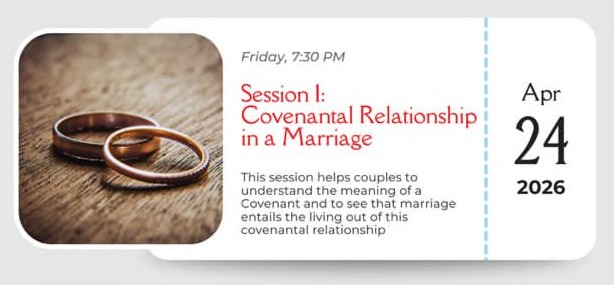
I attended the first of 4 talks about the Basic Theology of Marriage, and these are my notes.
Msgr James Yeo's presentation is such that even lay people like me, can understand it very simply, although he went quite fast, and have little opportunity to take notes completely.
I listened to most of it, and only jotted down certain more impactful things. These are my notes:
Fundamental Option
He mentioned about marriage being a Fundamental Option, borrowing a line from moral thrology. My later research on this shows that fundamental option is the "deep, overall direction of your life".
So marriage is a Fundamental Option, is my deep, ongoing decision to remain faithful and to love my spouse in God, especially when it is difficult
And my actions taken henceforth must reflect that decision. But what if I dont feel loving, etc? Lets go on.
Berith (בְּרִית)
Berith (בְּרִית) is a Hebrew word that means Covenant. Its not like a contract or any agreement, it is a sacred, binding relationship.
Marriage, in the Catholic context, is a covenant. It is not just a legal document, or a promise or even a vow.
Marriage as a covenant, means that I must be a self-gift, as a life-long union.
It is a covenant, like God covenant with Israel, He has been giving to Israel, eventhough Israel has failed God so many times at so many levels.
This covenant, ties in with marriage as a fundamental option.
Marriage should be Salvific
It is worth a reflection on my (our) marriage. Is my marriage salvific? Does my marriage save me?
What does this even mean? Don't get me wrong, Jesus saves me. My marriage by itself doesn't save me. Jesus gave marriage as a sacrament so that it imparts me grace, to help me live in holiness and be able to love and remain in fidelity.
Are my actions, in participation of this grace in my marriage? Does it help me become more holy? Does my marriage sanctify me?
How does it become Salvific?
It becomes salvific when I learn to give (of my self), and not take. So I expect not, and demand not. I give like how Jesus gave Himself for the Church.
It becomes salvific when I sacrifice of myself. This means for me to be painfully patient and gentle with my spouse, even when there is legit reasons to flip the table. For me to forgive and forgive, when there is a wrong, even when there's no apology. And to bear through all these, in humility. Self-sacrifice indeed.
It becomes salvific when I die to myself, to put my spouse and kids first. So I will have that chance to die for them, the way Jesus died for us.
All the above are exactly what Jesus did for us. And I must do the same.
Contract VS Covenant
Msgr James compared the details of contract and covenant side by side, but I'll list them here.
Contract:
- temporary
- focuses on conditions
- based on distrust
- for their own good
- no need for holiness
- legal stipulations
Covenant:
- forever
- focuses on relationships
- based on trust and intimacy
- for our good
- must be holy (scriptural and spiritual)
- ethical stipulations
And what are Ethical Stipulations?
- Fidelity (exclusive love) - no adultary, no emotional infidelity, no pornography, no masturbation (self satisfaction)
- Permanence (lifelong commitment) - "I will stay married, come what ever."
- Total self-gift - I give myself to you, my time, my body, my attention, my emotional presence
- Openness to life - We are open to human life, not closing off life deliberately (no contraceptives, abortion).
- Mutual sanctification - We help each other get to heaven.
- Among others.
What is the Opposite of Love?
The opposite of love, is not hate.
The opposite of love is selfishness.
- When I demand sexual intimacy, it is not love, it is selfishness.
- When I use the joint account money without accountability or responsibility, I am selfish to my wants/desire.
- When I over-focus on my work and leave the care-giving completely to you, I only care about what I want to achieve.
- When I get angry and throw a fit and start/persist on a cold war, no matter how justified, I am focusing on myself and only on what I feel.
- When I persist in a habit that I know hurts my spouse, my resistance to improve, my insistence to remain the same (because it is easier) is selfishness.
- What are your experience of "selfishness"?
Akoloutheo (ἀκολουθέω) - Discipleship
This one feels like a big teaching.
Akoloutheo is the Greek word for "follow", but this is not just "following" in the sense of walking behind a person, or taking the same career option as another.
Akoloutheo is discipleship. We need to apply akoloutheo in 2 ways, firstly and mostly, to Akoloutheo Jesus. And with our spouses.
Akoloutheo means:
- being at someone's side
- accompanying
- relationship (not just instruction-following)
To akoloutheo Jesus means to:
- Shared life (not just direction) - living the Way of life
- Imitation of character - Becoming like Jesus
- Loyalty / attachment to a person - personal attachment, not just an abstract belief
- Trust in guidance - letting go of control, and trusting in Him
- Perseverance - Even when it gets difficult, to go on. Taking up the Cross daily.
The emphasis of akoloutheo is in following a person, not merely a set of beliefs or teachings. Most major religions teach similar things, but Jesus says to "Follow Me." not "follow my teachings".
And to akoloutheo in marriage is to:
- walk through life at your side, not just alongside your existence - Not parallel lives with occasional cooperation, but a shared journey
- follow your spouse's heart, not just merely keeping rules (not cheating, providing)
- learning what hurts them
- learning what gives them joy
- responding with love, not reaction
- adjusting your life for unity
- Follow Christ together, and follow each other to Christ
Marital Breakdowns
Marriages do not start with break rules, they start with:
- relaxing and/or stopping with living lives together or "walking together" (no more sharing the life)
- living separate lives (like room mates, no more sharing the journey)
- losing attentiveness to the other's heart (no more sharing the attachment)
Casti Connubii
Msgr James mentioned this document, issued in 1930s, about Christian Marriage. This document is the basis of Gaudium Et Spes, Familiaris Consortio, Humanae Vitae. But these shall not be discussed here.
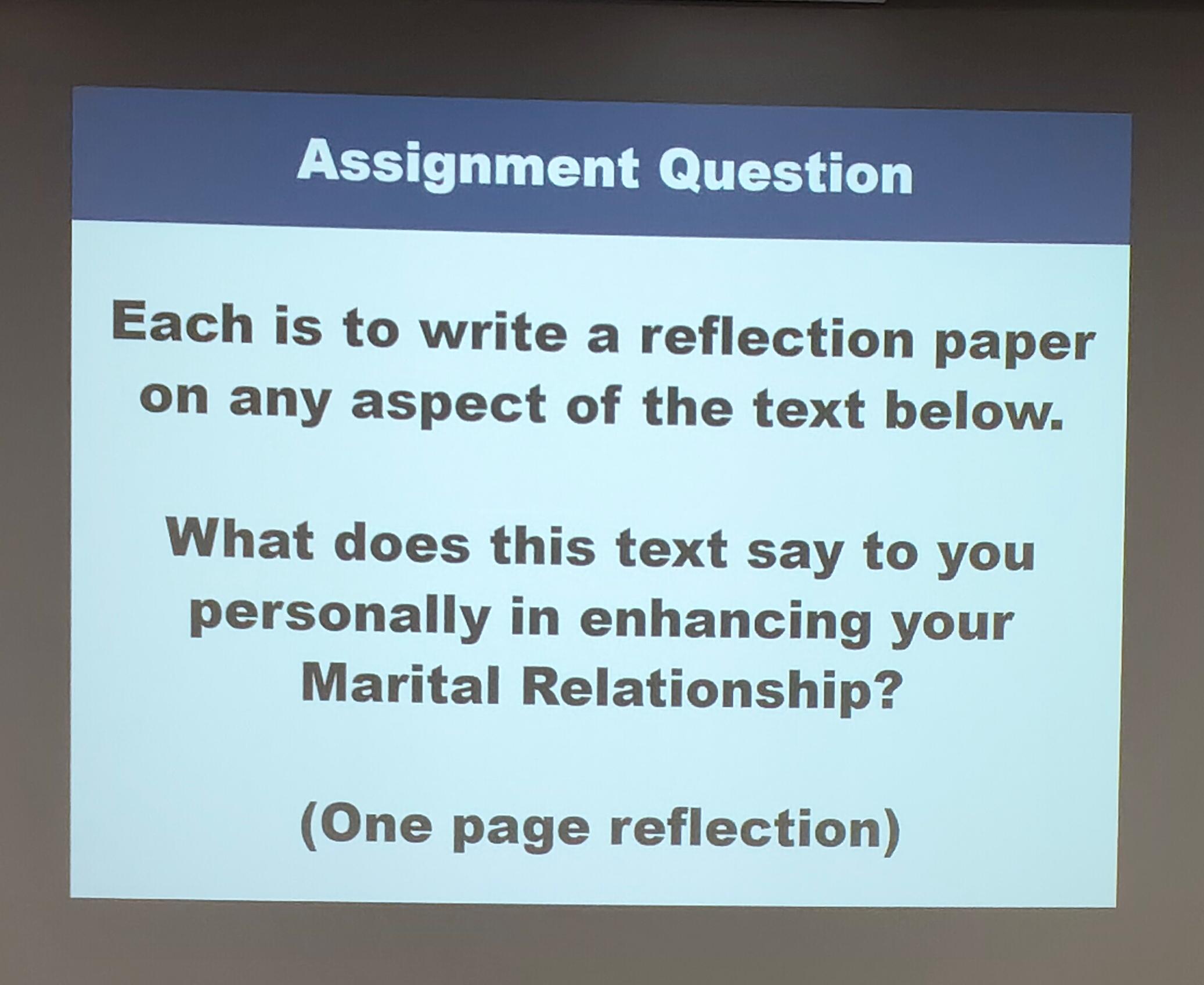
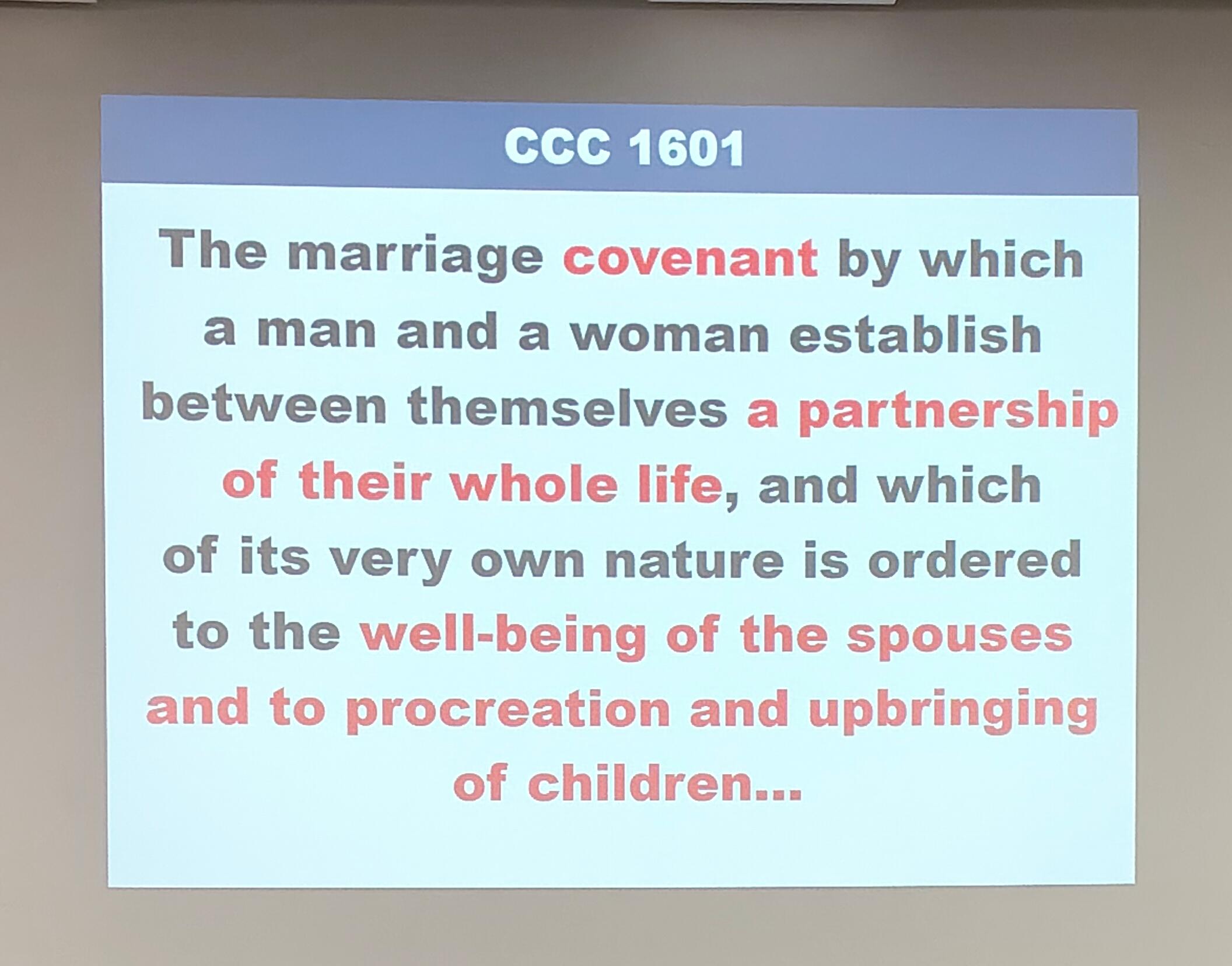
Assignment Question
This means for me, that our partnership is for life, forever, and it would benefit me to treat my wife as my worthy partner, my equal.
And since the nature of it is ordered to the well-being of my spouse, I endeavour to be the most patient and gentle as I can be, despite disagreements, despite impatience, despite transgressions.
In practice, this will mean for me, that despite how upset I am of how joint account money is mismanaged and lost, with no easy or quick way of replacement, I choose to remain patient and gentle in my tone in speaking to her about it. And I will keep calling her to improvement, while gently sharing with her how hurt and worried I feel about the mismanagement.
If I were to become angry and rageful, or even throw a tantrum, I would thus be prioritising my feelings over her, reacting, instead of responding in love and hence not ordering towards her well-being.
As to procreation and upbringing of children, unfortunately, she is not a Catholic, and I cannot in fullness apply the practices of Natural Family Planning (NFP), although I very much love to.
I do my best to bring up the children we have by being present, available, and participative. And in so doing, my wife will feel supported and not like she is the sole care giver, and has to do everything. I hope to be a worthy partner to her.
An excellent summary.
Knowing you both very well I can see the challenges and the call to rise above them to live authentically as “He loved us first”; and that is the way forward… through living and loving through Akoloutheo, to bring our spouses one day home… marriage is a journey. A road to Emmaus… pray that Zephyr will likewise walk this journey with you and Him in a threefold unity!
Well done