Basic Theology of Marriage by Msgr James Yeo (Part 2/4)

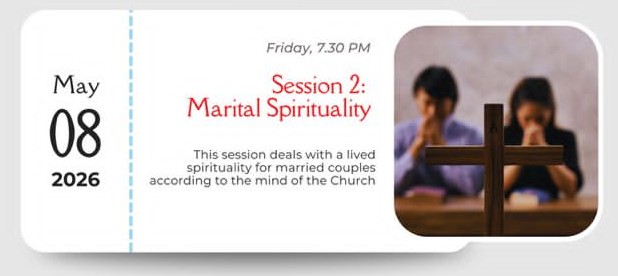
Session 2 teaches that marriage is not merely a relationship between husband and wife, but a marital spirituality modelled on the Holy Trinity, where spouses are called to truthful self-revelation, active presence, mutual indwelling, sacrificial love, and communion that leads them to holiness.
Introduction
In this session, Msgr James Yeo continued the theology of marriage by bringing together several important Church documents and theological themes, including:
- Familiaris Consortio
- Amoris Laetitia
- Gaudium et Spes
A key point was that marriage and family are two sides of the same coin. They share the same theology because both are rooted in covenantal relationship.
This continues from the idea of berith — covenant — which was discussed in Session 1. In Scripture, God’s covenant unfolds progressively:
- with Adam, involving the whole human race;
- with Abraham, involving his descendants;
- through Moses, involving the people of Israel;
- and finally, in the New Covenant, through Jesus Christ.
Marriage, therefore, is not merely a human arrangement. It is covenantal. It participates in the way God loves, binds Himself, reveals Himself, and remains faithful.
What is Spirituality?
Msgr James gave a basic description of spirituality as:
a way of assisting us to get in touch with ourselves, with others, and with God, so as to achieve sanctification.
This is important because spirituality is not just about private prayer or devotional practices. True Christian spirituality must lead us towards holiness.
He also explained that all spirituality must be:
- Scriptural
- Theological
- Liveable
“Scriptural” does not mean only quoting Bible verses. It means that the spirituality must be rooted in the revelation of God and consistent with the Christian faith.
A spirituality may take many forms, but it must not be heretical, paganistic, esoteric, or inimical to the Christian faith. Otherwise, it becomes a form of syncretism — mixing the Christian faith with beliefs or practices that are incompatible with it.
“Esoteric” refers to hidden, secret, or specialised spiritual knowledge supposedly accessible only to certain initiated people. For example, "higher knowledge" unavailable to ordinary believers.
“Inimical” means hostile to, harmful to, or opposed to something, in this case, Christianity. Inimical practices lead people away from Christ.
"Syncretism" means mixing different religions or belief systems together in a way that changes or compromises the original faith. Like, mixing Christianity with astrology, or treating Jesus as merely one spiritual master among many.
Different people may be at different stages of spirituality. What matters is whether the spirituality bears fruit.
For married couples, Msgr James said that they would do well to adopt together a marital spirituality.
In other words, a married couple cannot simply say, “I do not want marital spirituality with you.” Marriage itself requires a spirituality because marriage is a path of sanctification.
Marital Spirituality and the Holy Trinity
The Holy Trinity is a communion of three divine Persons: Father, Son, and Holy Spirit.
They do not exist for themselves, they do not exist for the other, they exist for communion.
Within the Trinity, there is an implicit covenantal relationship — the berith of the three divine Persons. God is not solitary. God is communion.
Marriage reflects this in a human way.
The Trinity is a communion of three Persons. Marriage is a communion of two persons.
If a married couple wants to imitate the Trinity, then they must first know who God is.
But this also raises another question:
Do I know my spouse?
And perhaps even more deeply:
How much have I revealed myself to my spouse?
Am I still hiding something from my spouse?
This is where Msgr James spoke about truthful revelation and unceasing communication.
Jesus says in Matthew 11:27:
“No one knows the Son except the Father, and no one knows the Father except the Son…”
This tells us that communion is connected to knowledge and revelation. The Father and the Son know one another in perfect love.
In marriage, spousal revelation must also be ongoing. Every day, I must continue to learn something about my spouse.
This is because the spouse is not static. A person changes through:
- motherhood,
- fatherhood,
- sickness,
- health,
- suffering,
- loss,
- ageing,
- and even death.
I cannot enter into communion with a person I do not know. Therefore, marriage requires constant, life-giving communication.
Communion: Ethos of Love, Not Ethos of Use
Communion can only be built on an ethos of love, not an ethos of use.
This is a very important point.
A marriage can become utilitarian. I may begin to see my spouse in terms of usefulness:
- Does she meet my needs?
- Does he help me?
- Does she make my life easier?
- Does he give me what I want?
- Is this relationship convenient for me?
But if the relationship is based on usefulness, then it is not true communion.
This also reflects my relationship with God.
If I treat God in a utilitarian way — only going to Him when I need something — then I may also treat my spouse the same way.
So the question becomes:
Who is Jesus for me?
If God is only useful to me, then my spouse may also become only useful to me.
But marriage is not ordered towards use. Marriage is ordered towards communion.
Marital Spirituality is Trinitarian
Msgr James described marital spirituality as fundamentally Trinitarian.
Marriage is not merely a human relationship but a participation in the life and love of the Holy Trinity.
He presented a definition of marital spirituality that emphasised discipleship in Christ, the work of the Holy Spirit, and the call to grow into the holy, faithful and abiding love that exists within the Trinity itself.
This is a profound topic that deserves further reflection and will be explored in a separate article.
Marriage Exists for Communion
Marriage is a great mystery:
The husband does not exist for the wife nor the wife exist for the husband.
A the same time, the husband does not exist for himself nor the wife exist for herself.
Marriage exists for communion.
If I want to exist only for myself, I should not get married.
But if I exist only for the other, there is also no true communion.
True communion requires both persons to be fully present, fully themselves, and fully given to each other.
This is where the Trinity becomes the model.
In the Trinity, the Father is not the Son. The Son is not the Holy Spirit. The Holy Spirit is not the Father. The Persons are distinct, but perfectly united.
There is no absorption.
Absorption
Msgr James spoke about the danger of absorption in marriage.
Absorption happens when one spouse overpowers the other, controls the other, or acts as superior to the other.
This is not Trinitarian.
In the Trinity, the three divine Persons are distinct but equal. One Person is not absorbed into another.
Likewise, in marriage, unity does not mean that one spouse disappears into the other. Marriage does not destroy the personhood of either spouse.
The husband remains truly himself. The wife remains truly herself. But they are called to become one in love.
The Theology of Presence / Incarnational Principle
Another major theme was presence.
Marriage requires presence. Presence is not optional. It is indispensable and irreplaceable to the quality of the marriage.
This connects to the Incarnational Principle.
God did not save us from a distance. The Word became flesh. God became present to us in Jesus Christ.
Likewise, in marriage, love cannot remain abstract. It must become embodied. It must become present.
This presence is expressed in the words of Genesis and repeated by Jesus:
“They are no longer two, but one flesh.”
God is indivisible. So marriage is also indivisible.
Therefore:
- your family becomes my family;
- your time becomes my time;
- your life becomes my life;
- your pain becomes my pain.
Although marriage is made up of two individuals, the married life must become indivisible.
My absence can make or break the marriage. My presence builds intimacy.
A simple movement can be seen:
Presence → Communion → Intimacy
Without presence, communion weakens. Without communion, intimacy suffers.
Perichoresis: Indwelling in One Another
Msgr James also introduced the word perichoresis.
Perichoresis refers to the mutual indwelling of the divine Persons of the Trinity. Jesus says in John 14:10:
“I am in the Father and the Father is in me…”
The Father, Son, and Holy Spirit dwell in one another without confusion, domination, or separation.
Applied to marriage, this means that spouses are called to dwell in one another’s lives.
This is not merely physical. It is spiritual, emotional, mental, and relational.
In adultery, something deeply serious happens because a form of presence and indwelling is given to someone outside the covenant. This is why adultery is not merely physical. There is also a spiritual and emotional dimension.
Intimacy is not just bodily. It is also spiritual and emotional.
This is why a spouse cannot simply disappear from the other’s life. A husband or wife has a rightful concern for the whereabouts and presence of the other.
In Genesis, God asks Adam:
“Where are you?”
This question is not only about physical location. It is also about relational presence.
A spouse can be “missing in action” even while physically present. One may be sitting in the same room, but mentally, emotionally, or spiritually absent.
Marriage requires active presence — the sharing of spirit, mind, and heart.
Marriage as a Reflection of Divine Love
Marriage must become a reflection of the divine, abiding, and faithful love of the Trinity.
Spousal love must reflect this.
This leads to a serious question:
Have I arrived?
Of course, most of us have not. But this is the direction of marital spirituality.
Marriage is not just about avoiding divorce, avoiding adultery, or fulfilling duties. It is about becoming an icon of God’s faithful love.
The New Covenant: Christ the Bridegroom
Msgr James then moved from the Old Covenant to the New Covenant in Jesus Christ.
In the New Covenant, Jesus is revealed as the Bridegroom, and the Church is His Bride.
Revelation 19:7 says:
“Let us rejoice and exult and give him the glory, for the marriage of the Lamb has come, and his Bride has made herself ready…”
Christ’s love for us cannot become defective.
But our love for Christ can become defective.
This is similar in marriage. Love can become wounded, weakened, or defective. But it can also be rectified and repaired.
God continually calls His people back:
“Come back to Me.”
This is the call to return to the covenant.
No matter how unfaithful the bride becomes, Christ always calls her back.
This is also true in the sacrament of marriage. The grace of the sacrament can be revived.
Msgr James mentioned that of the seven sacraments, three can be “revived” in this sense:
- Baptism
- Marriage
- Priesthood / Holy Orders
These sacraments confer a permanent reality. Even when the grace seems dormant because of sin, neglect, or weakness, the person can return to the covenant and allow that grace to bear fruit again.
Marriage and the Cross
Ephesians 5:31–32 says:
“For this reason a man shall leave his father and mother and be joined to his wife, and the two shall become one flesh. This mystery is a profound one, and I am saying that it refers to Christ and the Church.”
Marriage is a mystery that points to Christ and the Church.
Therefore, marriage is also a cross.
This does not mean marriage is miserable. It means marriage stretches discipleship to the full.
The love of the Cross must become the measure of spousal love.
Jesus does not love only when it is easy. He loves unto death. He gives Himself completely.
That is the standard of Christian marriage.
Eros, Philia, and Agape
Msgr James distinguished between different kinds of love:
- Eros — romantic or desiring love
- Philia — friendship love
- Agape — sacrificial, self-giving love
These are not the same.
In John 21:15–17, Jesus asks Peter whether he loves Him. In the Greek, there is a movement between agape and philia, which shows different dimensions of love.
For marriage, Msgr James emphasised that only agape can sustain a marriage.
Eros is important, but it cannot sustain a marriage by itself.
Philia is beautiful, but even friendship alone is not enough.
Marriage requires agape — sacrificial love.
But agape is tiring. It is draining. It is the love of the Cross. It requires self-sacrifice.
And this brings us back to a point from Session 1:
The opposite of love is not hate.
The opposite of love is selfishness.
Selfishness destroys communion. Agape restores and sustains it.
Marriage as a Path to Holiness
The sharing question was:
How do you see your marriage as a path to holiness? Give some concrete ways.
This question brings the whole session into practical life.
Marriage is a path to holiness because it constantly calls me out of myself.
It calls me to:
- be present when I want to withdraw;
- communicate when I want to keep silent;
- forgive when I feel justified in resentment;
- serve when I feel tired;
- listen when I want to defend myself;
- reveal myself when I want to hide;
- remain faithful when love feels difficult;
- choose communion instead of selfishness.
Marriage sanctifies because it forces love to become concrete.
It is easy to say I love God. But marriage asks whether I can love this particular person, in this particular home, with these particular weaknesses, wounds, habits, and needs.
That is where holiness is formed.
Ultimately, Christian marriage is not merely about companionship or romance. It is a vocation to communion, modelled after the life of the Trinity itself. Through truthful self-giving, faithful presence, sacrificial love, and continual return to the covenant, husband and wife become instruments of each other’s sanctification.
Reflection Questions
- What are the challenges and obstacles in your marriage in achieving Perichoresis?
- How do you see your Marriage as a Path to Holiness?Give some concrete ways!
If you like, you can post your answers in the space below.
Stefen's Reflection
What struck me most was the idea that the Persons of the Holy Trinity do not exist merely for themselves, nor solely for one another. Rather, they exist in perfect communion. Their communion becomes the model for our own marriages and points us towards a deeply fulfilling and joyful relationship.
Of course, this does not happen automatically. It requires effort and intentionality. We need to keep learning about our spouse, sharing ourselves honestly, communicating openly, and seeking each other's good. Through this continual self-giving and mutual understanding, intimacy is built and strengthened.
Another important insight for me was the call to agape love. Unlike romantic feelings, agape is often a matter of choice. It is a sacrificial love that seeks the good of the other even when it is difficult or inconvenient.
I know I cannot achieve this kind of love by my own strength alone. But with God's grace and help, I believe I can grow towards it.