Ride Hailing: Practical Guide to Maximising Income
Intra-Page Menu
Click here to jump straight to what you want to see:
Quick Start Checklist
- Register for a PDVL/TDVL
-
Set goals & hours
-
Register for PDVL/TDVL discounts
-
Apply fuel card
-
Pre-book Tribecar slots
-
Track all costs
-
Review last month’s metrics
Why This Guide Exists
Hello, and welcome!
You’re here because you’re exploring ride-hailing as a source of income — whether as a side hustle or a primary gig. That’s a smart step toward taking control of your time and earnings.
In this guide, I’ll share my experience, strategies, and practical tips for making the most of ride-hailing across multiple platforms like Grab, Tada, and others — so you can maximize your earnings efficiently and sustainably.
Who Am I?
Hi, I’m Stefen. I’ve spent most of my career in the aviation industry — running a company trading aircraft spare parts internationally, holding a commercial pilot license, and training as a coach.
Recently, due to circumstances beyond my control, I transitioned back into ride-hailing to generate immediate income while building other projects. Driving Grab, Tada, and other platforms has given me hands-on insight into what works and what doesn’t — experience I want to share with you.
This isn’t a full-time career for me, but it’s a practical way to earn while maintaining flexibility. If you’re exploring ride-hailing as a part-time or supplementary income stream, you’re in the right place. Here, you’ll find strategies, tips, and lessons to help you get up to speed quickly and safely.
My Ride-Hailing Philosophy
My approach to ride-hailing is simple and practical.
The goal is to keep costs low and earn as much as possible within the limited hours we can realistically commit.
To do this, I use a multi-platform approach, combining:
Grab - Primary Ride Volume

Tada - Targeted Time Based Usage

Tribecar - Flexible Vehicle Access

You can click the links above to explore how I use each platform in more detail.
I'll also share referral codes. These benefit both of us with sign-up rewards — if there’s free money on the table, it makes sense to use it.
What If I Dont Have A Car?
Neither do I.
I don’t recommend renting a car by the month unless you’re driving full-time.
Instead, I use Tribecar to access Private Hire Vehicles (PHVs) for Grab and other ride-hailing jobs. Many cars in the Tribecar network are eligible for this use.
There is a strategy to using Tribecar effectively, especially if ride-hailing is meant to be an income generator, not a lifestyle choice.
Monthly rentals mean paying for:
-
Days you don’t drive
-
Nights you’re not working
-
Weekends you may not use
If you intend to drive full-time, monthly rental or ownership can make sense.
But for part-time or flexible hours, on-demand car access helps keep costs aligned with actual work.
This guide focuses on ride-hailing as a practical, part-time business — something you can run during spare hours without unnecessary financial pressure.
Platform Overview
A. Grab - Primary Ride Volume
In short, Grab works well as a primary ride-hailing platform because of:
-
Strong demand and faster job assignment
-
A well-integrated and reliable map system
-
Automatic handling of ERP charges
-
Clear and flexible money management
-
Structured incentive programs
Below, I’ll explain each of these from a driver’s point of view.
Strong Demand and Quicker Job Assignment
Grab has the largest market share in Singapore’s ride-hailing ecosystem. For drivers, this translates into consistent demand and shorter idle time.
1. Back-to-Back Jobs
Many times, before my current passenger alights, the next job is already assigned. This happens because Grab’s demand density is high — there is often another passenger requesting a ride near where I am dropping off.
2. Short or Zero Drive to Next Pax
It is common for the next passenger to be at the same drop-off location, or very nearby. Grab actively optimises this because shorter pick-ups improve platform efficiency.
For drivers, this means:
-
Less dead mileage
-
Lower fuel consumption
-
More completed trips per hour
3. Demand Across Time and Location
At almost any time of day, and in most parts of Singapore, turning on the Grab Driver app results in a job ping fairly quickly.
In practice, this means I earn money:
-
Sooner — less waiting time
-
Faster — next job often lined up
-
More efficiently — shorter distances to pick-ups
Superior Map System
The Grab Driver app has a well-integrated and mature map system.
It typically:
-
Suggests the fastest route
-
Offers alternative routes
-
Allows quick adjustments (e.g. turning via slip roads or avoiding red-light delays)
For me as a driver, this means:
-
Everything is visible on one screen
-
Less distraction
-
Less need to switch between apps
I generally don’t need to use Waze or Google Maps unless I want a second opinion.
Electronic Road Pricing (ERP)
When you pass through an ERP gantry, the Grab Driver app automatically detects the charge and adds it to the passenger’s fare.
This removes two common risks:
-
Forgetting the ERP amount
-
Losing money by failing to charge it
It is still prudent to cross-check occasionally, but in general this automation works well.
Other ride-hailing platforms may require drivers to manually track ERP charges and remember to add them at the end of the trip — which introduces friction and error.
Money Management
Grab’s money management system is straightforward and flexible.
Earnings can be withdrawn to a linked bank account almost immediately after completing a ride.
You can direct funds to:
-
A linked bank account
-
Grab Wallet (user app, not driver app), which can then be used for GrabFood, Grab rides, PayNow transfers, or bank transfers
In practice, this allows you to split income flows.
Personally:
-
I send most earnings to a household account
-
I send a smaller portion to a personal spending account
This makes tracking and discipline easier.
Incentives
Grab offers multiple incentive programs that are generally easy to understand.
It’s important to remember that incentives exist to ensure enough drivers are on the road to meet demand — so they should be approached strategically, not emotionally.
Incentives typically fall into three broad categories:
1. Day-Type Incentives
Often called Special Trip Bonuses.
These apply to specific time windows (e.g. 7am–10am, 6pm–12am) and expire at the end of the day.
2. Multi-Day Incentives
Often known as Drive Star Bonuses.
These run across several days (e.g. Mon–Thu or Fri–Sun) with cumulative trip requirements.
3. Monthly Incentives
Such as Grab Streak Bonuses.
These reward sustained volume over a month (e.g. 300+ rides). Maintaining streaks across consecutive months can unlock higher tiers and percentage-based fee rebates.
Each incentive usually comes with conditions such as:
-
Minimum acceptance rate
-
Minimum driver rating
-
Maximum cancellation rate
They may also be limited by:
-
Time windows
-
Days of the week
-
Zones or locations
-
Vehicle types
One real example:
On a particular day, I was seven rides short of completing two incentive targets. With my wife’s support, I drove an additional four hours, completed the requirements, and earned an extra $51 + $11 on top of normal fares.
What About Tada, Gojek, Ryde, and Other Platforms?
Yes — other platforms may advertise lower commission or lower fees.
However, in my experience, they also have fewer users. This often means:
-
More time waiting for jobs, or
-
Longer drives just to pick up a passenger
Both are inefficient.
So while we may “pay more” to Grab in commissions, what we get in return is:
-
Faster job pings
-
Shorter dead mileage
-
Better overall earning efficiency
In other words, the income opportunity and working experience with Grab are simply stronger.
That said, it can be smart to use more than one app — strategically.
For example, I sometimes use Tada between 6:00am and 10:00am.
During morning peak hours:
-
Demand for Tada rides is strong
-
Prices are attractive for passengers
-
Pay is good for drivers, since Tada does not charge commission
So I mix and match, and observe what works best.
As for other platforms — I’ve tried a few.
Personally, I find that Grab alone is already sufficient for my needs.
Although it’s possible to run two or more driver apps on the same phone, I choose not to.
What happens if two apps ping at the same time?
Aiyoh  — need to cancel one, get penalised.
So I keep it simple:
-
One app at a time
-
Less stress
-
Less headache
-
Simple life
B. Tribecar — Flexible Car Access for Ride-Hailing
Tribecar gives me access to Private Hire Vehicles (PHV) in a flexible and cost-effective way.
If ride-hailing is an income generator rather than a long-term career identity, this flexibility matters more than anything else.
You only pay for the hours you actually use the car.
What Tribecar Gives You
After registering for a Tribecar account (enter stepchoo@gmail.com as referral code), submit either:
-
Private Hire Car Driver’s Vocational Licence (PDVL), or
-
Taxi Driver’s Vocational Licence (TDVL)
to Tribecar support.
Once approved, you’ll receive special Private Hire Driver rates, which are significantly lower than standard consumer bookings and often far cheaper than monthly rentals.
This makes Tribecar especially suitable for:
-
part-time drivers
-
weekday-only drivers
-
drivers balancing other commitments
PHV Vehicle Categories Available
Always refer to the Tribecar app for the latest category and availability in your area.
Economy – Sedan
Honda Jazz, Mitsubishi Attrage, Toyota Corolla Altis, Honda Vezel, Mazda 2 Sedan, Nissan Qashqai, Mitsubishi Lancer EX, Nissan Note
Economy – MPV (7-seaters)
Toyota Wish, Mazda 5 (3rd Gen)
Standard – Sedan
Suzuki Swift Mild Hybrid, Mazda 3 Sedan, Honda Shuttle Hybrid, Toyota Prius C Hybrid, Honda Civic, Toyota Aqua Hybrid, Toyota Vios, Honda Fit, Nissan Sylphy, Toyota Corolla Altis
Standard – EV Sedan
MG 4 EV, MG 5 EV, MG ZS EV
Standard – SUV
Honda Vezel (2nd Gen), Honda Vezel Hybrid, Honda HR-V (2nd Gen), Nissan Qashqai (2014–2020)
Standard – MPV (6–7 seaters)
Toyota Sienta Hybrid (2016–2022), Renault Grand Scenic Diesel, Honda Freed Hybrid, Honda Mobilio, Chevrolet Orlando
Standard Plus – Sedan
Mazda 3 Sedan Mild Hybrid, Toyota Corolla Altis (12th Gen)
Standard Plus – SUV (5-seaters)
Nissan Kicks e-POWER Hybrid, Toyota Raize Hybrid
Standard Plus – MPV (7-seaters)
Toyota Sienta Hybrid (2022 onwards), Honda Freed Hybrid (2016–2024)
Rental Rates & Timing (What You Must Understand)
PHV rental rates vary by time of booking:
-
Super Off-Peak: Weekdays 1am–7am
-
Off-Peak: Weekdays 7am–5pm
-
Peak: Mon–Thu 5pm–1am
PHV driver rates are valid:
-
Monday 12am to Friday 5pm
-
Exclude public holidays and eves
 Always check the latest pricing in the app or on Tribecar’s official page.
How to Choose the Right Car
Cars are usually available in HDB carparks, so install the app and check what’s near you.
General guidance:
-
Hybrids and EVs usually cost less per kilometre
-
Fuel savings directly increase your profit
-
Sometimes a slightly longer walk or cycle pays off
When I started, there were no hybrid cars in my estate.
I booked one a few estates away and cycled 5–10 minutes to the car.
That small effort reduced fuel costs and increased my take-home income.
Booking Strategy (For Consistent Income)
If you want consistency, pre-book.
Last-minute bookings risk:
-
no car available
-
forced car type changes
-
disrupted income plans
My approach:
-
I book next month’s schedule before this month ends
-
I block all required timeslots in one go
-
I usually top up about $1,000 to support this
If plans change and my usual car isn’t available:
-
I book a similar car elsewhere
-
Sometimes it’s newer and more fuel-efficient
-
The short walk or cycle is worth it
Tribecar Driver Rewards Program
Tribecar rewards drivers who use their cars for Grab driving:
-
100+ hours/month: $30 promo code
-
301–500 hours: $100
-
500+ hours: $200
⚠️ This is claims-based, not automatic.
You must:
-
Email support@tribecar.com
-
Do so before the 10th of the month
-
Attach screenshots of your Grab Driver history
Refer to Tribecar’s official terms for full details.
Updating Vehicle Details in Grab & Other Apps
Each time you rent a Tribecar vehicle for ride-hailing, you must update the vehicle details in:
-
Grab
-
Tada
-
Gojek
-
other platforms you use
Do this early, as admin approval can take time.
Tribecar will email:
-
Log card
-
Insurance documents
-
PHV decal image
You’ll need these for verification.
Common Mistakes to Avoid
1. Returning the Car Late
Tribecar imposes strict late return penalties, even if you are late by just one minute.
-
Penalty: $10 for every 15 minutes late
-
This applies immediately after your booking end time
If you are the next hirer and the previous user returns the car late, you may:
-
seek compensation (you get 50% of the late fees), or
-
cancel the booking with a full refund
Driver tip:
Always plan to end your last trip 20–30 minutes before your booking ends.
Do not “squeeze one last job”.
2. Making Changes to Your Booking
Tribecar does not allow amendments to existing bookings.
However, there are limited workarounds:
-
Extending the end time:
You can extend directly in the app before the booking starts, if the slot is available. -
Extending the start time:
Make a new booking with the earlier start time that ends just before your original booking.
The system will automatically merge the two bookings.
For all other changes:
-
you must cancel and rebook
-
cancellation fees may apply
Driver tip:
Think through your schedule before confirming bookings. Flexibility costs money.
3. Incurring Cancellation Fees
Cancellation fees exist to cover administration and business loss.
Current structure (subject to festive-period changes):
-
Less than 24 hours: 80% of rental charge
-
24–48 hours: 50% of rental charge
-
More than 48 hours: $0.88 (inclusive of GST)
During festive periods, cancellation fees may differ.
Driver tip:
Avoid “speculative bookings”. Book only hours you are confident you can drive.
4. Returning the Car with Fuel Reserve Light On
For non-Car Club vehicles:
-
The car must be returned without the fuel reserve light on
-
If the next hirer reports this:
-
they receive $25 compensation
-
the fine is charged to you
-
(Car Club vehicles and EVs have different policies.)
Driver tip:
Refuel earlier, not at the last minute. Stations get crowded during peak hours.
5. Breaking Rules and Incurring Fines or Admin Charges
Tribecar has a list of rules that, if breached, result in:
-
fines, or
-
administrative charges
These include issues related to cleanliness, misuse, documentation, or improper handling.
Driver tip:
Assume the next hirer will inspect the car carefully — because they will.
6. Filling the Car with the Wrong Fuel
This is rare — but very expensive when it happens.
-
Always check the fuel type before pumping
-
If a mistake occurs:
-
call Tribecar support immediately
-
they may arrange to drain the tank
-
This will incur fees, but it is far cheaper than engine replacement.
7. Not Monitoring Fuel Consumption
If you plan to do this beyond a few weeks, fuel becomes a major variable cost.
Track:
-
mileage driven
-
fuel topped up
-
dashboard fuel consumption
Compare different cars available to you.
Choose vehicles that:
-
consume less fuel
-
suit your driving style
Lower fuel usage = higher real profit.
8. Clicking Away TribeShield (Motor Excess Rider)
You may be tempted to opt out to save money.
Don’t.
-
Cost: $0.60 per hour, capped at $6 per day
-
Without it, accident repairs can seriously hurt your cash flow
For income-driving, this is risk containment, not an expense.
9. Opting Out of Personal Accident Insurance
This one depends on you.
-
If you already have your own personal insurance → opting out is reasonable
-
If you don’t → Tribecar’s coverage is useful
Cost: 3.5% of total booking fees
Bonus Tip: Early Collection Window
You can collect the car up to 15 minutes before your booking starts — for free.
Use this time to:
-
inspect the car
-
adjust seating
-
settle in calmly
Small advantage, but it helps.
My Typical Driving Day
Driving between 1am and 7am may be the cheapest — but I don’t recommend it for everyone.
I value sustainability.
As I get older (I turned 46 in 2025), sleep and recovery matter more than squeezing every dollar.
My usual pattern:
-
Start: 5–6am
-
End: around 6.30pm
-
Return car by 7pm
-
Drive 3–5 days per week
The goal is consistent income, not burnout.
Car Setup SOP Before Driving
Having a repeatable setup reduces stress and improves focus.
My standard setup:
-
Place 1.6L water bottle between seats (hydration is critical).
-
Position coffee thermos in reachable cup holder.
-
Install seat cushion and lumbar support towel.
-
Insert NETS FlashPay card into IU / ensure ERP payment system is active.
-
Connect phone charger (long cable).
-
Mount phone holder on right side of steering wheel (personal ergonomic preference).
-
Wear sunglasses and bone conduction headset.
A consistent setup improves readiness and reduces distraction.
Hydration & Pee Stops
Hydration is essential for alertness and long-term health.
Do not intentionally restrict water intake to avoid restroom breaks. That harms focus and bladder health.
Pee Stop Strategy
-
Use natural drop-off locations near toilets
-
Take pre-emptive breaks when near known facilities
-
Utilize public carparks within grace periods responsibly
Common stop locations:
-
Petrol stations
-
Hawker centres
-
Public parks
-
Malls
-
Hospitals
-
Office buildings
Breaks are typically 2–5 minutes and help maintain alertness and professionalism.
Plan breaks intelligently rather than reactively.
Costs & Money Management
If ride-hailing is to be treated as a business, then costs must be understood clearly.
Below is how I calculate my numbers for a typical month.
For simplicity, my public table is summarised. My personal working sheet contains deeper breakdowns, but what you see here reflects the real financial picture.
1. Fuel Cost Calculation
As of February 2026, the pump price at SPC is SGD 2.87 per litre.
Ride-hailing drivers typically receive:
-
Minimum 23% discount
-
Higher discount tiers if more than 50L per week is purchased
To calculate fuel cost:
Litres pumped × fuel price − discount
(or simply refer to the final amount on the receipt)
The fuel figures reflected in my table are:
-
After discount
-
After GST
-
Based on actual receipts
This keeps the numbers realistic and not theoretical.
2. Rental Cost Calculation
Total rental cost is calculated by summing all booked hours.
Do note:
Rental rates vary based on booking time:
-
Super Off-Peak
-
Off-Peak
-
Peak
If a discount or rebate code is used, that amount is deducted first.
Tribecar then adds the following charges:
-
Vehicle Insurance Excess Rider
($0.60 per hour, capped at $6 per day) -
Personal Accident Insurance
(3.5% of total booking fees — I opt out as I have my own coverage) -
Platform Fee
(Fixed $1.20) -
GST (prevailing rate)
The rental figures shown in my table are inclusive of all the above, except Personal Accident Insurance.
3. Earnings Calculation
I separate earnings into:
-
Base ride fares
-
Incentives
-
Tips
In my personal spreadsheet, I analyse:
-
Base fare only
-
Base + incentives
-
Base + incentives + tips
For simplicity on this site, I combine them to show total gross earnings.
This makes it easier for new drivers to understand overall profitability.
CPF / Medisave Contributions (Important)
The earnings shown do not yet reflect Medisave deductions.
Platforms automatically deduct Medisave contributions and set them aside.
This means:
Actual take-home cash will be slightly lower than the “Net Earnings” shown.
Medisave is calculated based on the full passenger fare,
before the platform deducts its commissions or fees.
This is important because many drivers misunderstand this part.
Platform drivers may be required to contribute to CPF, depending on:
-
Age group
-
Whether they have opted into full CPF contribution
-
Current CPF regulations
In my case, I have opted out of full CPF contribution.
Therefore, only the required Medisave portion is deducted from my earnings.
If a driver opts into full CPF contribution:
-
The platform provides the “employer portion” contribution
-
However, the driver’s take-home cash will be lower, as a larger percentage of earnings is set aside for CPF
This means:
Drivers who opt into full CPF contribution may see lower cash take-home pay, but higher retirement savings.
CPF policies may change over time. Always refer to the official CPF Board website for the latest rules and contribution rates.
Cash flow and retirement planning are two separate decisions. Each driver should decide based on personal financial circumstances.
What This Means for Real Take-Home Pay
When calculating true profitability, consider:
-
Fuel
-
Rental
-
Insurance add-ons
-
Platform fees
-
GST
-
Medisave deduction
Only after accounting for these can you determine:
Is this sustainable income — or just busy activity?
Ride Hailing Metrics & Performance Review
Tracking metrics is essential. Without numbers, emotions take over. With numbers, decisions become objective.
This page documents my monthly ride-hailing performance, cost structure, and strategic adjustments.
1. Core Performance Metrics
These are the key numbers I track every month.
Gross Revenue
Total earnings before any deductions.
This includes:
-
Base fares
-
Incentives / bonuses
-
Tips (if applicable)
Platform Breakdown
Revenue by platform:
-
Grab
-
TADA
-
others
This shows which platform produces the strongest yield per hour.
Online/Productive Hours
Total hours logged online and accepting jobs.
Productive hours exclude meal and restroom breaks.
This is important because:
Revenue means little without knowing the time cost.
Trips Completed
Number of completed trips per month.
This helps track:
-
Average trips per hour
-
Job density
-
Platform efficiency
Revenue Per Hour (RPH)
Formula:
Gross Revenue ÷ Online Hours
This is one of the most important indicators.
It answers:
Is my time being used efficiently?
Revenue Per Trip
Formula:
Gross Revenue ÷ Trips Completed
This shows:
-
Quality of jobs
-
Impact of short vs long trips
-
Effect of surge zones
2. Cost Metrics
Revenue without cost tracking is incomplete.
Vehicle Rental
Monthly rental paid (including all the Tribecar fees).
Fuel Costs
Total fuel expense.
Track:
-
Fuel efficiency
-
Cost per km
Parking & ERP
Include:
-
CBD parking
- Home base season parking (if you are renting by the month)
-
ERP charges (All reimbursed with the fares)
-
Waiting time parking
Maintenance (if applicable)
Include:
-
Servicing (Tribecar covers this)
-
Tyres (if observed to have bald spots, report in the Tribecar app)
-
Car wash (Tribecar reimburses carwashes and gives a $5 appreciation coupon)
-
Repairs
Total Operating Cost
Sum of:
Rental + Fuel + Parking + Maintenance
3. Net Performance
Net Profit
Formula:
Gross Revenue – Total Operating Cost
This is the real number that matters.
Net Profit Per Hour
Formula:
Net Profit ÷ Online Hours
This determines:
Whether ride-hailing is worth the time compared to other income opportunities.
4. Strategic Indicators
These are decision-making metrics.
Best Working Time Blocks
Which time periods produced:
-
Highest RPH
-
Strongest surge
-
Most consistent demand
Platform Strength Comparison
Which platform performed better this month?
-
Highest RPH
-
Best incentives
-
Lowest idle time
Adjustment for Next Month
Examples:
-
Reduce off-peak driving
-
Focus on airport runs
-
Avoid low-yield zones
-
Increase weekend night blocks
Every month can produce a strategic improvement.
5. Why I Publish This
Transparency helps:
-
Other drivers learn from real numbers
-
I hold myself accountable
-
Business thinking improves
Ride-hailing is not just “driving”.
It is operations management at micro scale.
January 2026 — Real Example Breakdown
Below is a simplified snapshot of my January 2026 ride-hailing performance.
This reflects actual rental, fuel, earnings, and net calculations.
Personal analysis columns have been removed for clarity.
In January, I intentionally allocated several daytime blocks to work on my other business. As a result, some of my driving hours were concentrated in the evenings.
My operating targets are:
-
$350 revenue for a full day drive (~13 hours)
-
$250 revenue for an evening drive (~6 hours)
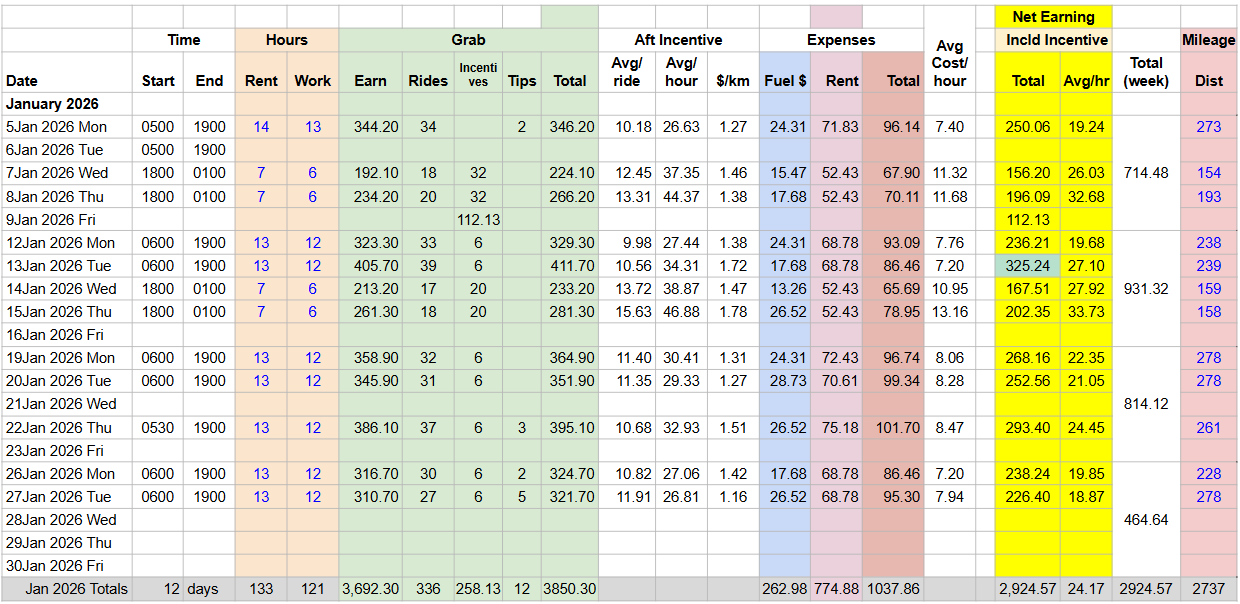
Key Performance Figures
-
Total Rented Hours: 185
-
Total Productive Hours: 175
(Productive hours exclude meal and restroom breaks.) -
Gross Revenue: $3,962
-
Total Cost (Fuel + Rental): $1,037
-
Net Profit: $2,924
-
Revenue Per Hour: $32.75
-
Net Profit Per Hour: $24.17
-
Total Mileage: 2,737 km
-
Mileage Per Hour: 22.62 km/hr
-
Earnings Per KM: $1.07/km
-
Fuel Economy: 23 km/L
Observations & Strategic Insights
Evening driving (6pm–12am) consistently yielded the highest revenue per hour, despite the higher rental cost associated with those time blocks.
One key factor was the use of Grab Shift bookings, which restrict pickups and drop-offs within a defined zone. This significantly reduced unnecessary mileage and improved fuel efficiency.
However, income variability remains high. Even within a designated shift zone, earnings fluctuate depending on micro-location demand and supply conditions.
This reinforces the importance of positioning, timing, and disciplined hour selection rather than simply maximizing total driving time.
Fuel Planning & Operational Discipline
Fuel is one of the largest variable costs in ride-hailing.
Good fuel discipline improves net profit per hour without increasing driving time.
Below is my personal system.
Start of the Day Routine
I collect the car 15 minutes before the booking time to allow for setup.
My first stop is usually SPC, as it is the nearest station to my pickup location.
This gives me:
-
A consistent starting point
-
A full tank baseline
-
No mid-day fuel interruptions
Petrol Station Discounts
Most petrol brands in Singapore offer special discount schemes for PDVL drivers.
For SPC:
-
Application can be done online via their PDVL programme page.
-
Station staff are generally helpful in guiding the process.
-
SPC is transitioning from RFID sticker identification to QR-based app verification.
Additional rebates may be available when paying with:
-
POSB Everyday Card
-
American Express cards
I personally use the POSB Everyday Card. All rental, fuel, and NETS FlashPay top-ups are charged to this card. This helps with both rebates and expense tracking.
For other petrol brands, check directly with their stations or official websites for PDVL discount arrangements.
Fuel Stop Strategy
I prefer to top up once before starting the day.
Reasons:
-
Avoid wasting productive time mid-day
-
Avoid over-fuelling and leaving excess fuel for the next hirer
-
Maintain predictable operating costs
Mid-day top-ups are done only if necessary.
Fuel Planning Policy
When operating a new vehicle, there will be a short learning phase of over-fuelling and under-fuelling. This is normal.
During this phase, I record:
-
Litres topped up
-
Distance travelled (odometer reset after fuelling)
-
Fuel gauge change (bars or distance remaining)
-
Remaining fuel at end of day
-
System-calculated fuel economy (km/L)
Over time, patterns become predictable.
My Typical Planning Benchmarks
-
Grab Shift days: ~270 km
-
Non-shift days: ~350–400 km
Through data collection, I observed:
-
Grab Shift days require approximately 1 litre per booked hour
(e.g., 13 hours ≈ 13 litres) -
Non-shift days typically require ~18 litres
This predictability comes only from consistent tracking.
Adjusting for Leftover Fuel
If the previous hirer leaves fuel in the tank (thank you!), I estimate based on assumed fuel economy.
Example:
-
150 km remaining
-
Assume 25 km/L
-
Estimated remaining fuel ≈ 6L
Leaving 2L (50km), I deduct 4L from my planned top-up amount.
This prevents over-fuelling.
Managing End-of-Day Fuel
I aim to return the car with around 40–50 km remaining.
This provides:
-
Buffer margin
-
Avoidance of Fuel Reserve warning
-
Professional handover for next hirer
If I still have more than 1–1.5 productive hours remaining and fuel is low, I may perform a minimal top-up if expected earnings exceed the fuel cost.
Decision rule:
If 1 hour can reasonably generate $30 and fuel costs $13, the top-up is justified.
Minimum Fuel Top-Up Discovery
Each vehicle behaves differently.
In one vehicle I operate, the digital fuel system does not register changes below approximately 5–6 litres.
Through experimentation, I learned:
-
Topping up 3L → no gauge change
-
Topping up 4L → still no change
-
Topping up 6L → gauge updates
Therefore, 6L is the effective minimum detectable top-up.
Understanding your vehicle’s fuel system prevents unnecessary repeat top-ups.
Understanding Fuel Remaining
Fuel gauges are estimations.
Some vehicles display:
-
Fuel bars
-
Distance remaining (km)
In my current vehicle:
-
Fuel Reserve light activates below ~30 km remaining
-
I aim to return at ~50 km remaining
Distance remaining is influenced by:
-
Driving style
-
Expressway vs city driving
-
Load and road conditions
It is not exact.
Mid-Day Fuel Confidence Check (Optional)
Because the distance-remaining display is dynamic, I sometimes perform a mid-day efficiency check.
Example:
-
Starting range after top-up: 240 km
-
Distance travelled after 5 hours: 120 km
-
Remaining range displayed: 140 km
Difference between starting and current display suggests 100 km used, but actual distance achieved was 120 km.
Efficiency factor:
120 ÷ 100 = 1.2
If I want to return with 50 km remaining and current display shows 90 km, I multiply:
90 × 1.2 ≈ 108 km realistic remaining distance (based on my driving style).
This provides a more grounded estimate.
Final Note
Fuel planning is not about squeezing every cent.
It is about:
-
Predictability
-
Discipline
-
Data-driven operation
-
Protecting profit per hour
Small improvements in fuel management compound over months.
Referral Codes
Disclaimer
The figures and strategies here reflect my personal monthly data. Ride-hailing earnings vary by time, area, platform policies, and regulatory changes. Always verify platform payouts and local rules before relying on this for income decisions.
Got A Question or Want to be In Touch?
Send me a WhatsApp message.