The Communion of Saints
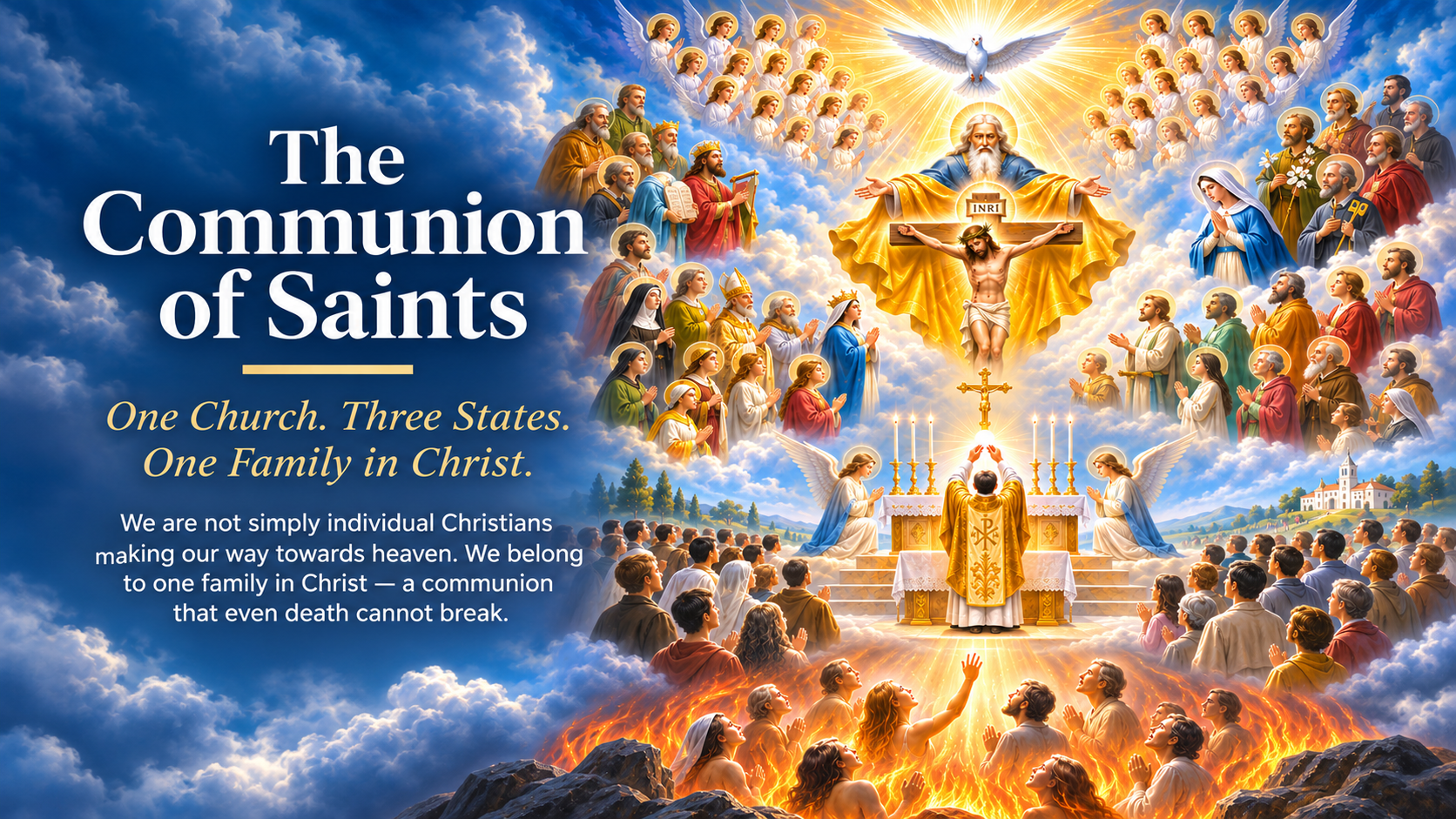
One Church. Three States. One Family in Christ.
Have you ever stopped to think about what we are actually saying when we recite the Apostles' Creed?
Every Sunday, we profess:
I believe in the Holy Spirit, the holy Catholic Church, the communion of saints, the forgiveness of sins, the resurrection of the body, and life everlasting. Amen.
We know these words. We have probably recited them hundreds, perhaps thousands, of times.
But what exactly is the Communion of Saints?
Who are these saints? Does this refer only to those who have been canonised by the Catholic Church? What about those of us still living on earth? What about our loved ones who have died?
And why do Catholics pray for the dead and ask the saints in heaven to pray for us?
The answer reveals something quite beautiful about our faith.
We are not simply individual Christians making our way towards heaven. We belong to one family in Christ — a communion that even death cannot break.
Let's explore what this means.
1. What Does the Communion of Saints Mean?
Before we explore the Communion of Saints, let's take a moment to understand the Creed in which these words appear.
Despite its name, the Apostles' Creed was not written by the twelve Apostles as a single document. Rather, it developed from the early Church's profession of faith, particularly the baptismal confession used in the Church of Rome.
From the earliest centuries, those preparing for Baptism were taught the essential truths of the Christian faith and called to profess what they believed. This profession of faith became a concise summary of the teachings handed down from the Apostles.
Over the centuries, its wording developed into the form we know today.
The Catechism describes it as the ancient baptismal symbol of the Church of Rome and a faithful summary of the Apostles' faith (CCC 194).
In other words, when we recite the Apostles' Creed, we are not simply repeating an old prayer. We are professing the faith that the Church has received, preserved and handed down through the generations.
And within this Creed, we find something particularly interesting:
The Communion of Saints.
The Catechism of the Catholic Church explains:
"After confessing 'the holy catholic Church,' the Apostles' Creed adds 'the communion of saints.' In a certain sense this article is a further explanation of the preceding: 'What is the Church if not the assembly of all the saints?'"
— CCC 946
In other words, the Communion of Saints is not something separate from the Church. It tells us something about what the Church actually is.
But there is something else worth knowing.
The expression Communion of Saints has two closely connected meanings.
First, communion in holy things.
We share in the spiritual treasures that Christ has given His Church. These include:
- The faith handed down by the Apostles.
- The Sacraments.
- The gifts and charisms of the Holy Spirit.
- The spiritual fruits of prayer, charity and good works.
And above all, we share in the Holy Eucharist, through which Christ unites us to Himself and to one another.
Second, communion among holy persons.
We are united with all those who belong to Christ.
Not just the people sitting beside us at Mass. Not just the Catholics in our parish, or even those living today.
This communion includes the faithful on earth, those undergoing purification after death, and those already enjoying the glory of heaven.
We will explore these three groups shortly.
But first, remember this:
The Communion of Saints means that we belong to one family in Christ. And this family is much bigger than what we can see.
(CCC 946–948)
2. What Do We Share as the Church?
We have seen that the Communion of Saints refers not only to the people who belong to Christ, but also to the holy things we share as members of His Church.
But what exactly are these holy things?
The Catechism explains that we share in the spiritual goods entrusted to the Church. These include our faith, the Sacraments, the gifts of the Holy Spirit, and the fruits of charity.
Let's look at what this means.
We Share One Faith
The faith we profess is not something each of us came up with individually.
It is the faith received from Christ, proclaimed by the Apostles, and handed down through the generations by the Church.
Think about it. The Gospel we hear at Mass, the Creed we profess, and the teachings we receive are part of the same faith that Christians before us believed and lived.
We are not inventing a new faith for every generation. We have received something precious, and we are called to preserve it, live it and pass it on.
When we profess the Apostles' Creed, we are expressing this shared faith. We stand alongside Christians throughout the centuries, professing the same God, the same Lord Jesus Christ, and the same hope of eternal life.
This is the communion of faith (CCC 949).
We Share in the Sacraments
The Sacraments are not merely individual religious experiences. They are sacred gifts Christ has entrusted to His Church.
Through them, God gives us His grace and draws us into deeper communion with Him and with one another.
Through Baptism, we become members of Christ's Body, the Church.
Through Confirmation, we are strengthened by the gifts of the Holy Spirit.
Through Reconciliation, our communion with God and the Church is restored when sin has wounded it.
And through the Holy Eucharist, we receive Christ Himself, who nourishes us and unites us more deeply as members of His Body.
Consider what happens when we receive Holy Communion. We are not receiving a different Christ from the person sitting beside us. We receive the same Lord, who brings us into communion with Himself and with one another.
The Sacraments are therefore not private possessions. They are gifts we share as members of the one Church (CCC 950).
We Share the Gifts of the Holy Spirit
God does not give every member of the Church the same gifts.
Some are called to teach, others to serve, to encourage, to lead, or to exercise other spiritual gifts.
St Paul explains this in 1 Corinthians 12. Just as a human body has many parts with different functions, so too does the Church have many members, each with different gifts.
But these gifts are not given simply for our own benefit.
They are given for the building up of the Church.
A person with the gift of teaching helps others understand the faith. Someone with a gift for serving helps those in need. Someone who encourages others may strengthen a person who is struggling.
The gifts given to one member can become a blessing to the entire Church.
This is the communion of charisms — the sharing of the gifts of the Holy Spirit (CCC 951).
We Share Our Spiritual and Material Goods
The early Christians understood that belonging to Christ meant looking beyond themselves.
In Acts 2:44–45, we read that the believers shared what they had and distributed their possessions to those who were in need.
Acts 4:32 describes the community as being of one heart and soul, with no one claiming that their possessions were exclusively their own.
This was more than generosity. It was an expression of their communion in Christ.
And this sharing is not limited to material possessions.
We also share spiritual goods: our prayers, sacrifices, acts of charity and good works. We can offer our prayers for someone who is suffering, our sacrifices for someone in need, and our good works for the benefit of others.
What God gives us is not meant to stop with us. It can become a blessing to others.
This is the communion of goods (CCC 952).
We Share in One Another's Charity
Finally, we share in the charity that unites us in Christ.
St Paul gives us a beautiful picture of this:
"If one member suffers, all suffer together; if one member is honoured, all rejoice together."
— 1 Corinthians 12:26 (RSVCE)
When someone in the Church grows in holiness, their example can inspire and strengthen others. When someone suffers, the rest of the community can support them through prayer, encouragement and acts of love.
Our lives are connected. Our love and good works are not isolated from one another.
This is why the Church teaches that the charity of one member can benefit the whole Body.
It is the communion of charity (CCC 953).
More Than Just Belonging to the Same Church
Now we can begin to appreciate the richness of the Communion of Saints.
We share one faith, the same Sacraments, the gifts of the Holy Spirit, and the spiritual and material goods that help build up the Church. We are united by the charity of Christ, and what one member receives can become a blessing to others.
We are not simply individuals who happen to attend the same church or believe the same things.
We are members of one Body, sharing in the life and gifts of Christ.
And this brings us to another beautiful aspect of the Communion of Saints.
This communion is not limited to those of us still living on earth.
It extends beyond death, because all who belong to Christ remain united in Him.
Let's look at the three states of the Church.
3. One Church, Three States
So, who belongs to this family?
The Catholic Church traditionally speaks of three states of the Church:
- The Church Militant.
- The Church Suffering.
- The Church Triumphant.
These are not three separate Churches. They are three states of the one Church, united in Christ.
Let's briefly understand each one.
The Church Militant
This is us!
Those of us still living on earth, making our pilgrimage towards heaven.
We are called to follow Christ, grow in holiness, resist sin and persevere in faith.
The word militant does not mean we are supposed to fight other people. It refers to the spiritual struggle we face as Christians.
The Church Suffering
These are the faithful who have died in God's grace and friendship but still need purification before entering the fullness of heaven.
This is what the Church teaches about Purgatory.
They are assured of eternal salvation, but they are not yet perfectly purified.
The Church Triumphant
These are those who have completed their earthly journey and now enjoy the glory of heaven, seeing God face to face.
They are the saints in heaven.
The Catechism explains that all three states belong to the one Church. Whether still making our earthly pilgrimage, undergoing purification, or already enjoying God's glory, all who belong to Christ remain united in Him (CCC 954).
Notice something important.
We are one Church, united by the same Lord, the same faith and the same love.
Let's take a closer look at each of these states.
4. The Church Militant: Our Journey on Earth
If you are reading this, you are part of the Church Militant!
But why does the Church use the word militant?
Because following Christ is not always easy.
We live in a world where we constantly encounter temptations, distractions, suffering and challenges to our faith.
We struggle against sin. We struggle against our own weaknesses. Sometimes, we even struggle to remain faithful when life becomes difficult.
St Paul reminds us:
"For we are not contending against flesh and blood, but against the principalities, against the powers, against the world rulers of this present darkness, against the spiritual hosts of wickedness in the heavenly places."
— Ephesians 6:12 (RSVCE)
Our battle is not against other people.
It is a spiritual battle.
That is why St Paul goes on to describe the armour of God: the belt of truth, the breastplate of righteousness, the shield of faith, the helmet of salvation and the sword of the Spirit (Ephesians 6:13–17).
We need these because we are called to persevere in our faith.
But here is something important about the Communion of Saints.
We do not fight this battle alone.
We are members of the Body of Christ.
St Paul describes the Church as one body with many members (1 Corinthians 12:12–27).
Each member has a role. Each member contributes to the good of the whole Body.
And he tells us:
"If one member suffers, all suffer together; if one member is honoured, all rejoice together."
— 1 Corinthians 12:26 (RSVCE)
Think about that.
When someone in our parish is struggling, we can pray for them.
When someone is sick, we can visit and care for them.
When someone is losing hope, we can encourage them.
When someone falls, we can help them get back up.
Our prayers, sacrifices, acts of charity and encouragement are not merely individual acts. They contribute to the life of the entire Church.
This is the communion we already experience here on earth.
And this communion does not end when someone dies.
Which brings us to the Church Suffering.
5. The Church Suffering: What Happens After Death?
What happens when a person dies?
The Church teaches that those who die in God's grace and friendship, but are not yet perfectly purified, undergo a final purification before entering heaven.
This is what we call Purgatory.
Now, let's be clear about something.
Purgatory is not a second chance at salvation.
It is not a place where someone has to earn their way into heaven.
Those who undergo this purification are already assured of their eternal salvation. They belong to God. Their final destination is heaven.
But they still need to be purified.
The Catechism puts it this way:
"All who die in God's grace and friendship, but still imperfectly purified, are indeed assured of their eternal salvation; but after death they undergo purification, so as to achieve the holiness necessary to enter the joy of heaven."
— CCC 1030
Think about it this way.
We are called to be holy, because God is holy (1 Peter 1:15–16).
And Scripture tells us:
"But nothing unclean shall enter it."
— Revelation 21:27 (RSVCE)
God does not merely want us to be forgiven. He wants us to be completely transformed and made holy.
Purgatory is part of that final purification.
But Why Do Catholics Pray for the Dead?
If those undergoing purification are already assured of heaven, why do we pray for them?
Because they are still part of the Communion of Saints!
Our relationship with them has not been erased by death.
And Scripture gives us an example of praying for the dead.
In 2 Maccabees 12:44–46, Judas Maccabeus and his men pray for their fallen companions and offer a sacrifice for them, so that they might be delivered from their sin.
The passage concludes:
"Therefore he made atonement for the dead, that they might be delivered from their sin."
— 2 Maccabees 12:45 (RSVCE)
This is one of the biblical foundations for the Catholic practice of praying for the faithful departed.
St Paul also writes about a person's work being tested by fire:
"If the work which any man has built on the foundation survives, he will receive a reward. If any man's work is burned up, he will suffer loss, though he himself will be saved, but only as through fire."
— 1 Corinthians 3:14–15 (RSVCE)
This passage is not, by itself, a complete explanation of Purgatory, but it is one of the Scriptural passages the Church considers when explaining this teaching.
When Should We Pray for the Dead?
The simple answer is: whenever we pray!
We don't have to wait until November, or until All Souls' Day, to remember our departed brothers and sisters.
We can pray for them:
- During our daily prayers.
- When we attend Mass.
- When we visit a cemetery.
- When we remember our deceased family members and friends.
- When we offer sacrifices or works of charity for them.
The Church particularly commends offering the Eucharistic sacrifice for the faithful departed (CCC 1032).
And this is something beautiful about the Communion of Saints.
We do not forget our departed brothers and sisters. We continue to pray for them, entrusting them to the mercy of God.
For a fuller explanation of Purgatory, its biblical foundations and what the Church teaches about it, see our separate article on Understanding Purgatory.
6. The Church Triumphant: Are the Saints Really Alive?
Now let's turn our attention to the Church Triumphant.
These are those who have completed their earthly journey and are now with God in heaven.
But are they really alive?
Some might think that once a person dies, they are simply gone. Their earthly life is over, and they can no longer participate in what happens here.
But Jesus tells us something different.
When questioned about the resurrection, He says:
"Now he is not God of the dead, but of the living; for all live to him."
— Luke 20:38 (RSVCE)
Those who have died in Christ are alive in Him.
And this is important because it helps us understand why Catholics ask the saints to pray for us.
Why Do We Ask the Saints to Pray for Us?
Let's start with something familiar.
Have you ever asked another person to pray for you?
Perhaps you asked your parents, your spouse, a friend, or someone from your parish.
We do this all the time.
And there is nothing wrong with it. In fact, Scripture encourages us to pray for one another.
St Paul writes:
"First of all, then, I urge that supplications, prayers, intercessions, and thanksgivings be made for all men."
— 1 Timothy 2:1 (RSVCE)
So, if we can ask our brothers and sisters on earth to pray for us, why should we assume that those who are alive in Christ in heaven cannot pray for us?
Of course, we must be clear.
Jesus Christ is our one and only Mediator between God and man (1 Timothy 2:5).
We do not place the saints above Christ, nor do we treat them as alternative mediators.
Rather, their intercession depends entirely on Christ and His saving work.
Just as our prayers for one another on earth do not compete with Christ's unique mediation, neither does the intercession of the saints in heaven.
Their prayers are made possible through their union with Him.
Does Scripture Show the Saints Praying in Heaven?
Yes! And Revelation gives us some particularly interesting passages.
In Revelation 5:8, St John sees the twenty-four elders fall before the Lamb, holding golden bowls full of incense, which are described as the prayers of the saints.
Then, in Revelation 8:3–4, an angel offers incense together with the prayers of all the saints before God.
And in Revelation 6:9–11, St John sees the souls of those who had been slain for the word of God. They are conscious and crying out to God, asking how long it will be before He judges and avenges their blood.
These passages show us that those who have died in Christ are not simply unconscious or inactive. They are alive before God, worshipping Him and participating in the heavenly worship.
Hebrews also gives us a beautiful picture:
"But you have come to Mount Zion and to the city of the living God, the heavenly Jerusalem, and to innumerable angels in festal gathering, and to the assembly of the first-born who are enrolled in heaven..."
— Hebrews 12:22–23 (RSVCE)
Notice that the author speaks of this heavenly assembly as something the faithful have come to.
The heavenly worship is not disconnected from the Church on earth.
We are already part of this greater communion.
Do Catholics Worship the Saints?
No.
This is an important distinction.
We worship God alone.
We honour the saints because of their holiness and their faithfulness to Christ. We look to their lives as examples, and we ask them to pray for us.
The Catechism explains that our communion with the saints is not merely about admiring their example. Through our fellowship with them in Christ, the unity of the whole Church is strengthened (CCC 957).
Our communion with the saints ultimately joins us more closely to Christ, from whom all grace flows.
So when we ask St Joseph, St Peter, St Paul, or any of the saints to pray for us, we are not taking anything away from Jesus.
We are asking our brothers and sisters in heaven to pray with us and for us.
The saints do not draw us away from Christ. They help direct us towards Him.
7. Can Death Separate Us From Christ's Body?
Now that we have looked at all three states of the Church, let's bring them together.
We have:
- The Church Militant, those of us still on earth.
- The Church Suffering, those undergoing purification.
- The Church Triumphant, those already in heaven.
But are these three groups still connected to one another?
Absolutely!
St Paul writes:
"For I am sure that neither death, nor life, nor angels, nor principalities, nor things present, nor things to come, nor powers, nor height, nor depth, nor anything else in all creation, will be able to separate us from the love of God in Christ Jesus our Lord."
— Romans 8:38–39 (RSVCE)
Death does not destroy our communion in Christ.
Those who are in heaven are still part of the Body of Christ.
Those undergoing purification are still part of the Body of Christ.
And we, who are still making our earthly pilgrimage, remain united with them.
This is why the Church does not treat the faithful departed as strangers.
We remember them. We pray for them. We ask the saints to intercede for us.
And we look forward to the day when we will share in the fullness of God's glory together.
The Eucharist: Heaven and Earth United
There is one particularly beautiful place where we experience this communion.
The Holy Mass.
When we attend Mass, we are not simply gathering as a group of people in a church building.
We are participating in the worship of the entire Church.
Listen carefully to the words of the Eucharistic liturgy.
In the Preface before the Holy, Holy, Holy, we proclaim:
"Therefore, with Angels and Archangels, with Thrones and Dominions, and with all the hosts and Powers of heaven, we sing the hymn of your glory, as without end we acclaim..."
Think about what we are saying.
We are joining our voices with the angels and saints in heaven, praising God.
And in the Eucharistic Prayer, we remember the saints and ask to share in their communion.
The Catechism explains that all the Sacraments unite the faithful with Christ and with one another, and that this communion is especially expressed in the Eucharist (CCC 950).
This is not merely symbolic togetherness.
Through the Eucharist, Christ unites us to Himself and to one another.
The Church on earth and the Church in heaven are united in worship of the same God.
When we celebrate Mass, we are not worshipping alone. We worship in communion with the whole Church, both in heaven and on earth.
8. Living the Communion of Saints
So, what does all this mean for us in our daily lives?
It means that our Catholic faith is not an individual journey.
We are part of something much bigger.
We are part of the family of God.
And this communion should change the way we live.
We Pray for One Another
Just as we ask our family and friends to pray for us, we should pray for one another.
We should remember those who are suffering, those who have lost hope, those who are struggling with their faith, and those who need God's mercy.
We Pray for the Faithful Departed
Our love for our deceased family members and friends does not have to end with their earthly lives.
We can continue to pray for them, especially by offering the Holy Mass for their intentions.
We Ask the Saints to Pray for Us
We have brothers and sisters in heaven who have already completed their earthly journey.
We can look to their example and ask for their intercession.
We Imitate the Saints
The saints are not simply people whose statues we see in churches.
They are examples of what it means to follow Christ.
Some were priests, some were parents, some were religious, some were young, some were old.
They came from different backgrounds and lived in different circumstances.
But they all shared one thing: they sought to love God and remain faithful to Him.
We are called to do the same.
We Support One Another
Remember what St Paul said?
If one member suffers, all suffer together. If one member is honoured, all rejoice together.
We should never underestimate the importance of our prayers, encouragement, acts of kindness and sacrifices.
They are all part of the life of the Church.
And finally, we should remember that we are all called to holiness.
We are not all called to become canonised saints in the same way, or to live identical lives.
But we are all called to become holy.
As St John reminds us:
"Beloved, we are God's children now; it does not yet appear what we shall be, but we know that when he appears we shall be like him, for we shall see him as he is."
— 1 John 3:2 (RSVCE)
This is our hope.
To be with God, to be transformed by His love, and to share in the glory of heaven.
One Church. One Family. United in Christ.
The next time you recite the Apostles' Creed, perhaps pause for a moment when you reach the words:
I believe in the communion of saints.
Remember that you are not alone.
You belong to a family that stretches beyond the walls of your church, beyond the boundaries of your parish, beyond countries and generations, and even beyond death.
There are brothers and sisters still walking their earthly journey alongside you.
There are faithful departed undergoing purification, whom we can remember in our prayers.
And there are saints in heaven, already enjoying the glory of God, who continue to intercede for us.
We are one Church.
We share one faith, one Lord, one baptism and one hope.
And we are all journeying towards the same destination.
Heaven.
May we help one another along the way, pray for one another, and never lose sight of the goal.
For we are not walking towards heaven alone.
We are walking together as the family of God.
Further Reading & Scripture References
Catechism of the Catholic Church
- CCC 194 — The Apostles' Creed as a faithful summary of the Apostles' faith.
- CCC 946–948 — The meaning of the Communion of Saints.
- CCC 949 — The communion of faith.
- CCC 950 — The communion of the Sacraments.
- CCC 951 — The communion of charisms.
- CCC 952 — The communion of goods.
- CCC 953 — The communion of charity.
- CCC 954–959 — The three states of the Church and the communion between them.
- CCC 960–962 — The Communion of Saints in brief.
- CCC 1030–1032 — Purgatory and prayers for the dead.
- CCC 1474–1477 — The communion of spiritual goods.
- CCC 2683 — The saints as witnesses and intercessors.
Scripture References
The Faith Handed Down
- Matthew 28:19–20 — Christ commissions the Apostles to make disciples and teach the nations.
- Acts 2:42 — The early Christians devote themselves to the Apostles' teaching, fellowship, the breaking of bread and prayers.
- 2 Timothy 2:2 — The faith is entrusted to faithful people who will teach others.
The Church as One Body
- 1 Corinthians 12:12–27 — The Church as one Body with many members.
- Ephesians 4:1–6 — One Body, one Spirit, one Lord, one faith and one Baptism.
- Romans 12:4–8 — Different gifts and functions within one Body.
The Communion of Spiritual Goods and Charity
- Acts 2:44–45 — The early Christians share their possessions.
- Acts 4:32–35 — The believers are of one heart and soul.
- 1 Corinthians 12:26 — When one member suffers, all suffer; when one is honoured, all rejoice.
- Galatians 6:2 — Bear one another's burdens.
The Church Suffering and Prayer for the Dead
- 2 Maccabees 12:44–46 — Prayer and sacrifice offered for the dead.
- 1 Corinthians 3:12–15 — A person's work tested by fire.
- Revelation 21:27 — Nothing unclean shall enter the heavenly Jerusalem.
The Church Triumphant and Intercession of the Saints
- Luke 20:37–38 — God is the God of the living.
- 1 Timothy 2:1–5 — Prayer and intercession, and Christ as the one Mediator.
- Hebrews 12:22–24 — The heavenly Jerusalem and the assembly of the first-born.
- Revelation 5:8 — The elders holding golden bowls of incense, representing the prayers of the saints.
- Revelation 6:9–11 — The souls of the martyrs crying out to God.
- Revelation 8:3–4 — The prayers of the saints rising before God.
Our Hope of Eternal Life
- Romans 8:38–39 — Nothing can separate us from the love of God in Christ.
- 1 John 3:1–3 — We are God's children and are called to become like Him.
Further Reading
- Catechism of the Catholic Church, Part One, Section Two, Chapter Three, Article 9: "I Believe in the Holy Catholic Church" — particularly the section on the Communion of Saints.
- Lumen Gentium, Chapter VII: "The Eschatological Nature of the Pilgrim Church and Its Union with the Heavenly Church" — Vatican II's teaching on the communion between the Church on earth and the Church in heaven.