Basic Theology of Marriage by Msgr James Yeo (Part 3/4)

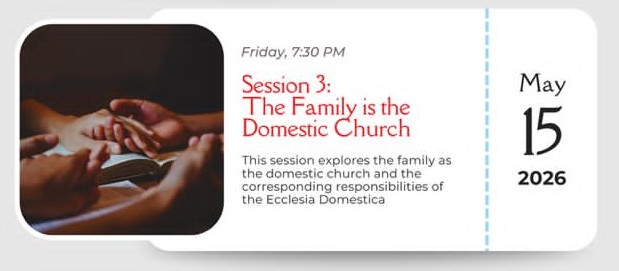
The Family as Domestic Church
In the previous sessions, marriage was presented as a covenant rooted in the life of the Holy Trinity and lived through communion, presence, and sacrificial love.
Session 3 takes the next step.
If marriage creates a family, then what is God's plan for the family?
Many people answer this question according to societal expectations:
- financial success,
- academic achievement,
- comfort,
- security,
- social status.
The Church, however, proposes something much deeper.
God's plan is that the Christian family becomes an Ecclesia Domestica – a Domestic Church.
The Family in God's Plan
The Bible contains several passages that can appear anti-family at first glance:
- Luke 14:26
- Luke 9:57–62
- Matthew 12:46–50
Yet Christianity is not anti-family.
Rather, Jesus expands the meaning of family.
The Church itself becomes family.
This was already visible in the early Christian communities where believers cared for one another's needs and shared life together as brothers and sisters in Christ.
The Church became a family for those who had none.
Ecclesia Domestica: The Domestic Church
The term Ecclesia Domestica means "Domestic Church."
The roots of this idea go back to the earliest Christians.
During periods of persecution and after being expelled from the synagogues, followers of "The Way" gathered in homes.
There they:
- prayed,
- listened to teaching,
- shared fellowship,
- broke bread together.
Before church buildings existed, the home was often the place where the Church gathered.
Thus the family home became the first place where faith was lived.
The Development of Church Teaching
Msgr James traced the Church's understanding of family through several major documents.
Arcanum Divinae Sapientiae (1880)
Marriage is:
- God's institution,
- a covenant,
- lifelong and indissoluble,
- elevated by Christ into a sacrament.
The family becomes the foundation of society.
Lumen Gentium (1964)
The family is called:
the Domestic Church.
The family becomes:
- a community of grace,
- prayer,
- love,
- virtue,
- and Christian charity.
The family is the first Church a child encounters.
Gaudium et Spes (1965)
The Council taught that:
"The well-being of the individual person and of both human and Christian society is closely bound up with the healthy state of conjugal and family life."
The family is the first cell of society.
Healthy families produce healthy societies.
Apostolicam Actuositatem (1965)
Every baptised person has an apostolate.
The family therefore possesses a mission.
It is not merely a recipient of ministry.
It becomes a minister itself.
Evangelii Nuntiandi (1975)
The family becomes the primary place where the Gospel is transmitted.
Parents are the first educators in the faith.
Before children listen to priests, teachers, or catechists, they observe:
- how Mum and Dad speak to one another,
- how they resolve conflicts,
- whether they pray,
- whether they forgive,
- whether they truly live what they profess.
Parents are the first evangelisers.
Humanae Vitae (1968)
Married love possesses two inseparable dimensions:
- unitive,
- procreative.
The communion of husband and wife remains open to the gift of life.
Familiaris Consortio (1981)
This becomes the great synthesis.
Msgr James referred to it as:
the Magna Carta of the Church's teaching on the family.
The Christian family is:
- a communion of persons,
- a Domestic Church,
- a community of love,
- a participant in the mission of the Church.
The Great Shift
A major theme of the session was the shift brought about by Vatican II and subsequent Church teaching.
The shift is complete:
From Church as Family → Family as Church
This is not merely wordplay.
It changes how we understand family life.
Many Catholics think:
- go to church,
- join a church group,
- become active in church.
The assumption is that Church exists primarily in the parish building.
But if the family truly is a Domestic Church, then the question changes:
Where is the Church?
The answer becomes:
The Church is also present in the Christian home.
Family Activities Are Church Activities
If the family is truly Church, then family life itself becomes ecclesial.
Activities such as:
- teaching children about faith,
- family prayer,
- caring for elderly parents,
- parenting,
- helping neighbours,
- family catechesis,
are not merely family activities.
They are Church activities.
Time spent building a loving, Christ-centred marriage and family is not a distraction from Church work.
It is Church work.
No False Choice Between Family and Ministry
Msgr James was careful not to create a false opposition.
The Church still needs:
- ministries,
- volunteers,
- parish leaders,
- catechists.
However, there should be no dichotomy between:
- Church ministry,
- family ministry.
The Christian family is itself a ministry.
Finding God at Home
One of the most striking ideas of the session was this:
If you cannot find God in your family, you are not going to find God anywhere.
The family invites us to discover God within ordinary life.
Living with others demands:
- patience,
- forgiveness,
- sacrifice,
- service,
- reconciliation.
In many ways it is easier to live alone.
But family life calls us to build a communion of persons.
That is where holiness is forged.
Everything is Grace
Msgr James drew upon the insights of Pierre Teilhard de Chardin.
The key idea:
Everything is grace.
Grace is not merely something received in extraordinary moments.
Grace is encountered in daily life.
For example:
- accepting responsibilities,
- loving faithfully,
- standing for truth,
- helping others,
- persevering through difficulties,
- refusing bitterness.
These ordinary acts become encounters with God.
Sacramental Theology and Family Life
The session then connected family life with sacramental theology.
God reveals Himself.
God reveals Himself through ordinary life.
Sanctification occurs when we respond to that revelation.
The Christian community then celebrates that encounter.
This means that the family becomes a privileged place where God acts.
Although the seven sacraments are primary channels of grace, they are not the only means through which God sanctifies.
The family itself becomes a place of encounter with God.
Msgr James even suggested that Familiaris Consortio comes close to viewing the family in sacramental terms.
Not as an eighth sacrament.
But as a privileged place where God's grace becomes visible and active.
The Incarnation Changes Everything
Because of the Incarnation:
the sacred enters the ordinary.
God has burst into human history.
Therefore ordinary family life can become holy ground.
Cooking meals.
Helping with homework.
Caring for ageing parents.
Forgiving one another.
Praying together.
All become occasions of grace.
The New Paradigm
The session proposed a number of paradigm shifts:
| Old Thinking | New Thinking |
|---|---|
| Church is family | Family is Church |
| Parish as centre | Home as centre |
| Parish catechesis | Family catechesis |
| Join church activities | Family activities are church activities |
| Church prayers | Family prayers |
| Sporadic family activities | Sustained family apostolate |
| Family depends on Church | Church depends on families |
| Sacraments are celebrated............ | Sacraments are lived |
The emphasis is not to weaken parish life.
Rather, it is to strengthen family life.
The Family Lens
Msgr James introduced the concept of a "Family Lens."
Every parish activity should be evaluated by asking:
How does this affect family life?
Does it:
- strengthen the Domestic Church?
- encourage family prayer?
- foster marriage?
- promote family time?
Or does it unintentionally undermine these?
A parish should be:
pro-family, not merely pro-activity.
Over-involvement in church activities can sometimes damage family life rather than strengthen it.
Family Apostolate
The Domestic Church has a mission.
Examples include:
- marriage preparation,
- helping struggling couples,
- assisting families in financial difficulty,
- supporting parents of special-needs children.
The family is not only evangelised.
The family evangelises.
The Four Roles of the Family
Drawing from Familiaris Consortio, the family has four primary tasks:
1. Forming a Communion of Persons
Building relationships of love and communion.
2. Promoting a Culture of Life
Welcoming and protecting life.
3. Sharing in the Life and Mission of the Church
Through:
- evangelisation,
- witness,
- catechesis,
- prayer,
- liturgy,
- vocations,
- ecumenism.
4. Participating in the Development of Society
Bringing Gospel values into the world.
The Mission of the Family and the Church
A key insight of the session was:
The mission of the family and the mission of the Church are the same.
The family is not a miniature version of the Church.
The family truly participates in the Church's mission.
A Holy Family Is Not a Perfect Family
The session concluded with a beautiful insight:
A family is holy not because it is perfect.
Rather:
A family is holy because God is present.
The goal is not to create a flawless family.
The goal is to make the home:
the dwelling place of God.
Reflection Questions
Remote Marriage Preparation
The Church teaches that marriage preparation begins long before engagement (remote), deepens during courtship (proximate), and culminates in the final preparation for the wedding itself (immediate).
The question posed was:
In what ways are you preparing your children now for their future marriages?
Parents are already doing marriage preparation for the children every day by:
- modelling love,
- teaching sacrifice,
- resolving conflicts well,
- speaking respectfully,
- teaching chastity,
- encouraging responsibility,
- and showing what a healthy Christian marriage looks like.
Family Health
Reflect on:
"The well-being of the individual person and of both human and Christian society is closely bound up with the healthy state of conjugal and family life."
Is your family healthy?
Self-Reflection
- Do I avoid difficult conversations?
- Do I use sarcasm or insinuation?
- Do I harbour resentment?
- Do I stop speaking for long periods?
- Do I bring old conflicts into new arguments?
- Do I intimidate or control?
- Do disagreements escalate into shouting or insults?
These questions remind us that the Domestic Church is not built through programmes.
It is built through daily conversion.
In the context of Session 3, remote preparation is really a Domestic Church responsibility. The first marriage preparation programme a child attends is not a parish course— it is the home they grow up in.
Stefen's Reflection on Session 3
What struck me most in this session was the idea that if the family is truly the Domestic Church, then every activity at home is a Church activity.
That means I need to be more mindful of how I behave at home. If our home is a holy place where God dwells with us, then I should strive to live in a way that reflects His presence.
I need to be gentler with my spouse and children, and to choose to love them deliberately, especially when it is difficult. Love is easy when everything is going well. It becomes truly meaningful when it is tested by tiredness, frustration, misunderstandings, and daily challenges.
I am also reminded of my responsibility to teach my children about God and to inspire them to desire Heaven. As parents, we are the first educators of the faith. We cannot leave this entirely to the parish, the school, or catechists.
The Book of Deuteronomy 6:4–9, also known as the Shema, beautifully expresses this responsibility:
Hear, O Israel: The Lord our God is one Lord; and you shall love the Lord your God with all your heart, and with all your soul, and with all your might.
And these words which I command you this day shall be upon your heart; and you shall teach them diligently to your children, and shall talk of them when you sit in your house, and when you walk by the way, and when you lie down, and when you rise.
And you shall bind them as a sign upon your hand, and they shall be as frontlets between your eyes.
And you shall write them on the doorposts of your house and on your gates.
This passage reminds me that faith is not something reserved for Sundays. It is meant to be woven into the ordinary moments of family life.
God's love will be taught to my children largely through me—through my words, my actions, my example, and the way I love their mother.
No, it is not going to be easy. But that is precisely why I want to take my faith more seriously and deepen my relationship with God the Father, Jesus Christ, and the Holy Spirit. Only with their grace can I learn to love more fully, give myself more generously, and help make our home a true Domestic Church.